The Syrian state news agency SANA reported that two Syrian soldiers were injured in the strikes.
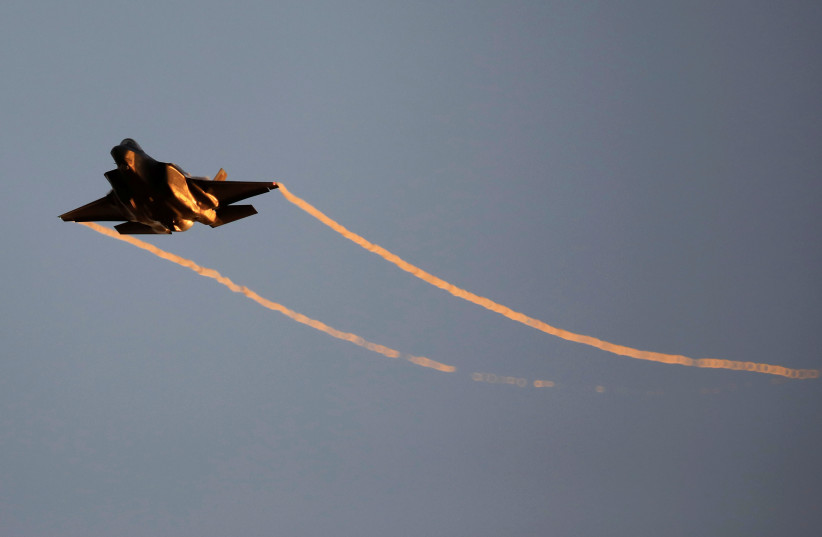
By TZVI JOFFREUpdated: OCTOBER 3, 2023 01:21An Israeli Air Force F-35 flies during an aerial demonstration at a graduation ceremony for Israeli air force pilots at the Hatzerim air base in southern Israel, June 27, 2019.(photo credit: REUTERS/AMIR COHEN)
Alleged Israeli airstrikes targeted sites used by the Syrian Army and Iranian militias in the Deir Ezzor region of eastern Syria on Monday night, according to Syrian reports.
The Syrian state news agency SANA reported that two Syrian soldiers were injured in the strikes.
Earlier, opposition-affiliated Syrian media news site reported that unidentified aircraft targeted sites belonging to Iranian militias in the Deir Ezzor region of eastern Syria.
At least one of the airstrikes hit a site near al-Bukamal, near the Iraqi-Syrian border, according to the reports. Additional airstrikes were reported near the cities of al-Mayadeen and Deir Ezzor.
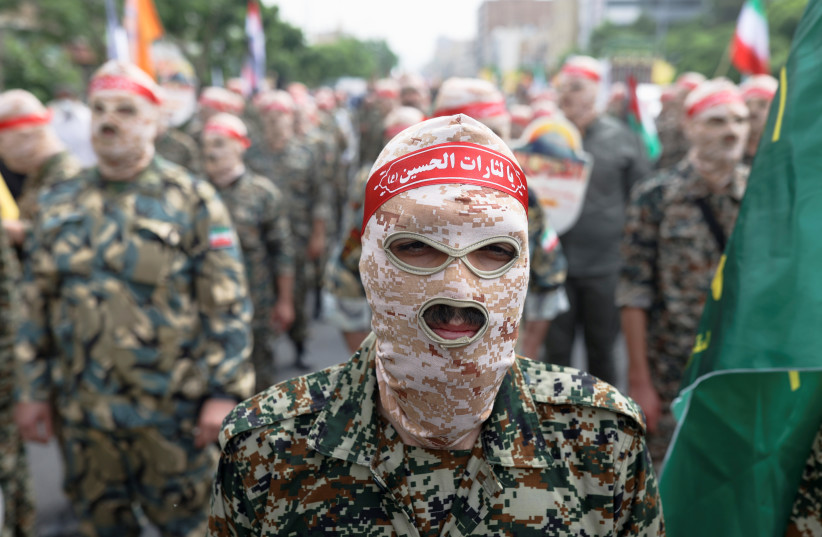
Members of a special IRGC force attend a rally marking the annual Quds Day, or Jerusalem Day, on the last Friday of the holy month of Ramadan in Tehran, Iran, April 29, 2022. (credit: MAJID ASGARIPOUR/WANA (WEST ASIA NEWS AGENCY) VIA REUTERS)
Second airstrike blamed on Israel in past few days
The airstrikes come just two days after alleged Israeli airstrikes reportedly targeted an Iranian weapons shipment near al-Dimass, northwest of Damascus. The Syrian Capital Voice news site reported that the airstrike targeted a building belonging to Hezbollah and that the shipment was headed to Lebanon. Syrian state media did not comment on that reported airstrike.
The leader of Hezbollah warned against al-Aqsa becoming “a Jewish synagogue.”
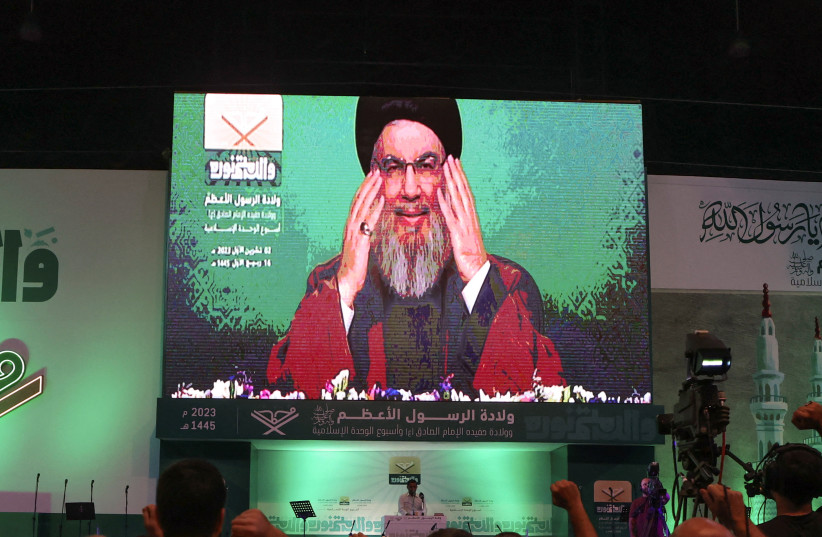
By TZVI JOFFRELebanon’s Hezbollah leader Sayyed Hassan Nasrallah addresses his supporters via a screen during a rally marking Prophet Mohammed’s birthday, in Beirut suburbs, Lebanon. October 2, 2023.(photo credit: MOHAMED AZAKIR/REUTERS)
Hezbollah Secretary-General Hassan Nasrallah condemned efforts by Saudi Arabia and other nations to normalize relations with Israel, calling such moves “an attack on al-Aqsa and an abandonment of Palestine” in a speech on Monday night.
“The Zionists must hear the voice of the Islamic world regarding the first qibla of Muslims (another name for al-Aqsa), and instead of hearing this voice, we find more movement towards normalization,” lamented the Hezbollah leader. “Any country that might sign a normalization agreement must be condemned because it is an attack on the Palestinian people and the al-Aqsa Mosque and strengthens the enemy.”
Nasrallah called for Arab countries to “bear responsibility for what is happening in Palestine, regardless of its preoccupations, and to also pay attention to what is happening to Al-Aqsa Mosque, so that the violation does not become a routine matter, and so it will not be divided in time and space or transformed into a Jewish synagogue.”
Some 2,163 Jewish pilgrims have visited the Temple Mount so far during the intermediary days of Sukkot, according to the Temple Mount Administration. Some 1,415 pilgrims went up on Monday alone, marking the highest number of visitors in a single day on the intermediary days of the holiday.
Jewish pilgrims visit the Temple Mount on the Sukkot holiday. October 2, 2023 (credit: TZVI JOFFRE)
‘We do not compromise on our land rights’
Nasrallah additionally referred to the dispute between Lebanon and Israel concerning the land border between the two countries, stating that the mediation on the matter is focusing on the town of Ghajar (which is split in half by the Blue Line) and the tents set up by Hezbollah in territory claimed by both Israel and Lebanon in the Shebaa Farms area.
Nasrallah stressed that the issue of mediation is for the Lebanese government to handle, not Hezbollah, and insisted that there is no reason to discuss demarcating the border between Israel and Lebanon because the border was already demarcated in agreements between the UK and France in the 1920s.
Nasrallah also referenced efforts to find oil and natural gas in Block 9, the area of Lebanese territorial water bordering Israel, claiming that “all indicators are positive” in the search for resources in the block.
“Our maritime rights, as well as our land rights, we take in full and do not compromise on. The resistance is present to support the Lebanese state in any step that contributes to liberating the land,” added the Hezbollah leader.
The State Archives said the collection offers “a fascinating glimpse into the decision-making process under conditions of uncertainty.”
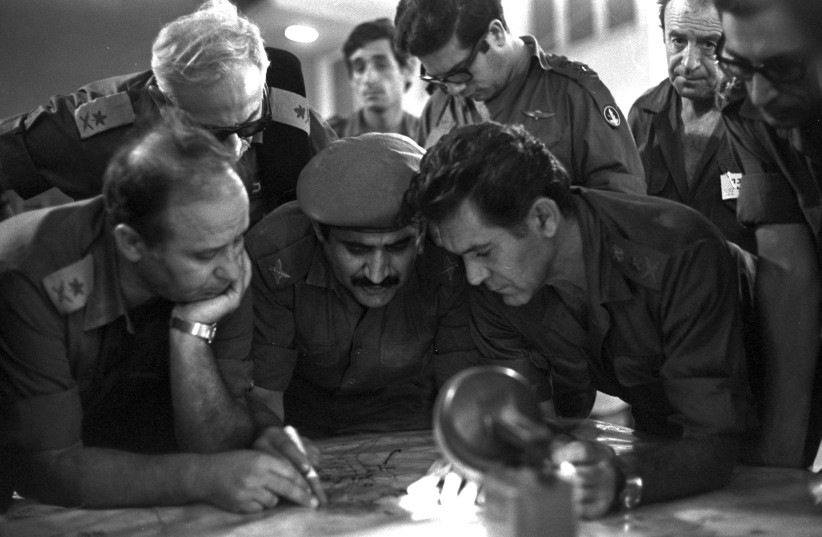
By STEVE LINDEUpdated: SEPTEMBER 30, 2023 12:10IDF chief David Elazar (right) confers with generals Yitzhak Hofi and Adam Yekutiel on October 10, 1973.(photo credit: DAVID RUBINGER/GPO)
“In the early afternoon of Yom Kippur, the Day of Atonement, on October 6, 1973, alarm sirens interrupted the silence of the fast, and the signal was given for the start of the Yom Kippur War, which has become a national trauma in Israel’s history. Although the war ended with military victories, 2,656 soldiers were killed, hundreds were taken prisoner, and over 7,200 soldiers and civilians were wounded. The fighting and its results were unbearably difficult for a country that just a few months earlier had celebrated its 25th Independence Day.”
This is the introduction to the newly declassified material from the Israel State Archives that has been posted on its website in accordance with a government decision ahead of the 50th anniversary of the Yom Kippur War. It comprises some 3,500 files, including about 1,400 paper files, 1,000 photographs, 800 audio clips, 150 transcripts, and eight videos.
The Israel State Archives (www.archives.gov.il/en/), which is part of the Prime Minister’s Office, said it has been working for the past two and a half years on making the files that tell the story of the Yom Kippur War – on the front lines, on the home front, and in the government – accessible to the public. “For the first time, it is possible to use original documents in order to research and feel the drama and the emotions among the public, the IDF, and the leadership, comprehensively and directly,” it said. “Some of the material relays the events minute by minute and allows us to relive the feelings of those who were present at the events.”
What has been declassified from the Yom Kippur War?
There are audio clips and photographs; transcripts and original files from government ministries and the military; diplomatic documents and testimonies; protocols of government and war cabinet meetings; high-level discussions and civil defense assessments; information on the home front; and much more.
This material, most of which was previously classified, has been checked and scanned, and cleared by the censor. It is now available as an archival collection of information on the war, beginning with decision-making by the country’s leadership in a time of uncertainty; the fighting on the various fronts; the Israeli home front; diplomatic contacts with Arab states; and mediation by the major powers until the 1974 Separation of Forces Agreement.
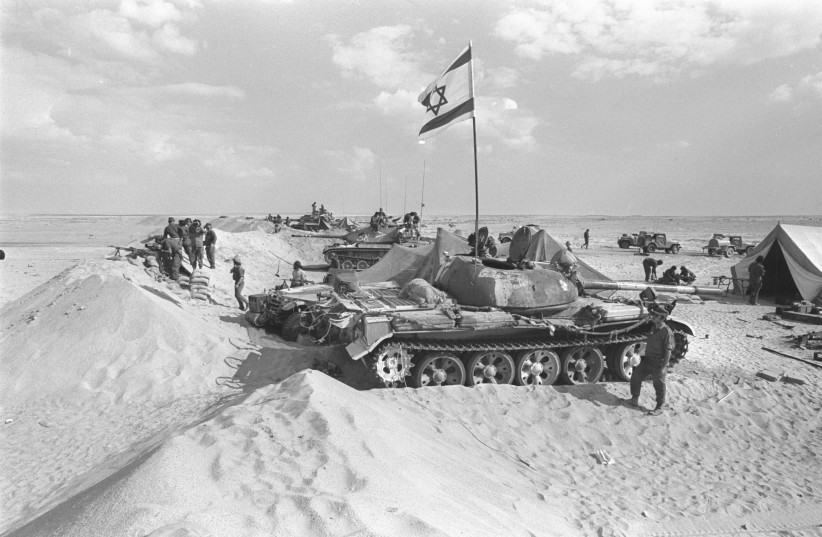
An IDF armored unit in its encampment on the east bank of the Suez Canal during the 1973 Yom Kippur War. (credit: YIGAL TOMARKIN/GPO)
The documents provide records of deliberations between then-prime minister Golda Meir and security chiefs in the days before Syria and Egypt launched a coordinated attack on October 6, 1973. A day before, Military Intelligence Directorate chief Eli Zeira (who turned 95 this year) signaled that the intelligence establishment did not have enough information on a planned attack by the Egyptians and the Syrians. “I must say, we don’t have sufficient proof that they don’t intend to attack,” he said. “We don’t have conclusive indications that they want to attack, but I can’t say based on knowledge that they aren’t preparing.”
Chief Archivist Ruti Abramovitz said the State Archives had endeavored to show “the 360-degree story of the war,” which affected every facet of life in Israel.
“The work to reveal the material was done by many employees,” she said. “This is the largest effort of its kind that the State Archives has ever undertaken…I invite the public to search for personal information, listen to the audio clips that can take us back in time, turn to the State Archives with requests for assistance if needed, and to look for answers to the open, and perhaps still bleeding, questions.”
The State Archives said the collection offers “a fascinating glimpse into the decision-making process under conditions of uncertainty.” For those interested in learning more about the Yom Kippur War, material can be accessed at https://catalog.archives.gov.il/en/publication/ykw-en/