(Israel Hayom via JNS) There is growing frustration among Israeli and Saudi officials over what they see as an overemphasis by Washington on having Jerusalem make concessions to the Palestinian Authority as a means of moving forward in the normalization process between the kingdom and the Jewish state.

Sources familiar with the ongoing talks said the Biden administration’s focus on this has hampered the process’s momentum and obstructed possible breakthroughs.

One source noted that on the big issues—including a possible U.S.-Saudi defense alliance that would come alongside a new civilian nuclear program in the kingdom—there are no insurmountable gaps because the disagreements are not substantial.

The source noted, though, that the American emphasis on the “Palestinian” aspect has been perceived as over the top and thus had the potential of undermining the entire process.

The criticism of the White House among Israeli figures and Saudi elements has been voiced behind closed doors. The officials stress that Riyadh is not part of the pressure on Israel to make major diplomatic concessions to the Palestinian Authority.

Saudi Crown Prince Mohammed bin Salman, in an interview with Fox News that aired on Sept. 20, refused to make demands from Israel on the “Palestinian” issue. He has stated that his expectation is merely that Israel “improve the lives of Palestinians.”

Nevertheless, Biden administration officials engaged in the mediation process between Israel and Saudi Arabia have floated a series of demands from Israel on this issue.

The U.S. asked Israel to allow the reopening of an independent American consulate general in Jerusalem that would effectively serve as a diplomatic mission to the Palestinian Authority. Additionally, pressure is mounting on Israel to increase economic support for the Palestinian Authority.

Israel has increased its financial support to the Palestinian Authority using various accounting measures and reducing tax collection. This has resulted in 350 million shekels ($91 million) of additional funds going to Ramallah from Israel since the beginning of 2023. This is apparently a result of U.S. pressure to strengthen P.A. President Mahmoud Abbas.

On Friday, U.S. National Security Council spokesman John Kirby said Jerusalem and Riyadh have “hammered out” the contours of a possible deal to bring the kingdom into the Abraham Accords.

The Trump administration-brokered accords normalized relations between Israel and four Arab nations: The United Arab Emirates, Bahrain, Morocco and Sudan.

“As in any complex arrangement, as this will inevitably be, everybody is going to have to do something. And everybody is going to have to compromise on some things,” said Kirby.

Saudi Arabia is not conditioning a peace deal with Israel on the establishment of a Palestinian state, Reuters reported over the weekend.

As part of an agreement, the Palestinian Authority could nonetheless receive a huge influx of Saudi aid as well as Israeli concessions that would fall short of statehood, said the report, citing three unnamed regional officials.

Last week, Tourism Minister Haim Katz became the first Israeli Cabinet minister to be granted an entry visa by the Saudi government, arriving in Riyadh to participate in a conference of the United Nations World Tourism Organization and mark World Tourism Day, celebrated annually on Sept. 27.

Concurrently, a delegation headed by Saudi Ambassador to Jordan Nayef al-Sudairi, Riyadh’s first-ever non-resident envoy to the P.A. and consul general to Jerusalem, traveled to Ramallah for a meeting with Palestinian Authority chief Mahmoud Abbas.

Israeli Prime Minister Benjamin Netanyahu recently told U.S. President Joe Biden during a meeting on the sidelines of the U.N. General Assembly debate in New York: “I think that under your leadership, Mr. President, we can forge a historic peace between Israel and Saudi Arabia.

“And I think such a peace would go a long way first to advance the end of the Arab-Israeli conflict, achieve reconciliation between the Islamic world and the Jewish state, and advance a genuine peace between Israel and the Palestinians,” said Netanyahu.

The Wall Street Journal reported the same week that Netanyahu instructed his country’s leading nuclear and security specialists to work with U.S. negotiators to find a compromise that lets Saudi Arabia enrich uranium.

Israeli officials are “quietly working” with the White House to develop a “U.S.-run, uranium-enrichment operation” in Saudi Arabia for a civilian nuclear program, a key condition of the kingdom for accepting a normalization agreement with Israel, officials from both countries told the Journal.

Netanyahu has repeatedly said that bringing Saudi Arabia into the Abraham Accords would constitute a “quantum leap” for peace in the Middle East.

In his address to the U.N. General Assembly, he said that a deal with Riyadh would have far-reaching implications, including encouraging other Arab nations to normalize relations with Israel.

He called the Abraham Accords “a pivot of history” and said the whole world is reaping their benefits. “All these are tremendous blessings,” said the premier.

Originally published by Israel Hayom.


Iran attacks impending Israel-Saudi peace as Gallant invited to US

“The big drama here is that the US is taking it upon itself to protect Saudi Arabia against Iran,” National Security Council Adviser Tzachi Hanegbi said.

 An Iranian missile is displayed during a rally marking the annual Quds Day, or Jerusalem Day, on the last Friday of the holy month of Ramadan in Tehran, Iran April 29, 2022. (photo credit: MAJID ASGARIPOUR/WANA (WEST ASIA NEWS AGENCY) VIA REUTERS)
An Iranian missile is displayed during a rally marking the annual Quds Day, or Jerusalem Day, on the last Friday of the holy month of Ramadan in Tehran, Iran April 29, 2022.
(photo credit: MAJID ASGARIPOUR/WANA (WEST ASIA NEWS AGENCY) VIA REUTERS)
Iranian President Ebrahim Raisi attacked the proposed “reactionary” Israeli-Saudi normalization deal, as Defense Minister Yoav Gallant is to head to Washington to meet with US Secretary of Defense Lloyd Austin and discuss security issues relating to that agreement and Iran.

Islamic countries that move toward normalized ties with the Zionist regime are on a “reactionary and regressive path,” Raisi said on Sunday, alluding to Saudi Arabia as he spoke at the International Islamic Unity Summit in Tehran.

Raisi called on the community of Islamic believers to unite against the crimes committed by the “agents of the United States and the Zionist regime,” as he emphasized the importance of freeing Palestine and Jerusalem.

“No concerned people in Palestine, Lebanon, and other Islamic countries are talking about compromise” and are instead focused on “resistance and standing against the enemy,” an option that will force retreat, Raisi said.

Today in Palestine, he said, the initiative comes from those who are engaged in jihad, a holy war.

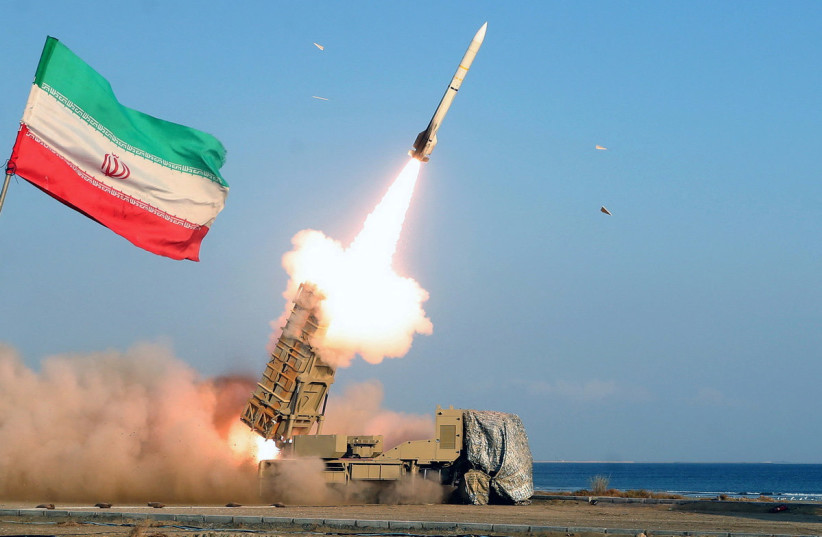
 A missile is launched during an annual drill in the coastal area of the Gulf of Oman and near the Strait of Hormuz, Iran (credit: REUTERS)
A missile is launched during an annual drill in the coastal area of the Gulf of Oman and near the Strait of Hormuz, Iran (credit: REUTERS)

He spoke as Washington and Riyadh are advancing toward a security pact that would require the US to respond to an attack against Saudi Arabia, including by Iran.

National Security Council Adviser Tzachi Hanegbi told Army Radio that the US for the first time is considering such a pact, which it has not signed with any other country since 1960.

“This is very important to the Saudis,” Hanegbi said. “The big drama here is that the US is taking it upon itself to protect Saudi Arabia against Iran,” he explained, noting that this has been particularly important to Riyadh since Iranian drones attacked its oil fields in 2019. Tehran has denied involvement in the attack.

Riyadh also wants a civilian nuclear program that includes uranium enrichment, Hanegbi said, as he dismissed the concerns of those who fear it could be used to militarize the program and allow Saudi Arabia to produce a nuclear bomb.

This deal will not harm Israeli security, Hanegbi said, stating that Jerusalem and Washington are completely aligned with regard to the safeguards needed for a Saudi nuclear program.

Prime Minister Benjamin Netanyahu and US President Joe Biden discussed a proposed Saudi deal that could also include an American-Israeli security pact when they met in New York last month.

Netanyahu held security consultations with Gallant on Sunday, with a focus on Iran, after Gallant accepted an invitation by Austin to visit Washington in October.

“At their meeting, the two will discuss ways to strengthen the special security ties between Israel and the US, and discuss the various security challenges and political opportunities in the Middle East,” the Defense Ministry said.

It would be the third face-to-face meeting between the two men, but the first in Washington. Until his meeting with Biden, Netanyahu had banned his ministers from visiting Washington.

The meeting comes as Iran continues to push toward a nuclear weapon capacity and United Nations Security Council Resolution 2231 is set to expire this month. It had banned Iran from developing long-range missiles capable of carrying a nuclear warhead.

Britain, France, and Germany said on Thursday they would retain ballistic missile and nuclear proliferation-related sanctions on Iran even after the resolution expires.

Israel has urged the international community to take a strong stand against Iran’s push for nuclear weapons, particularly now that it has enriched uranium to 60%.

It has also worked to prevent Iranian military entrenchment along its northern border and in Syria.

The Israel Air Force reportedly carried out an attack early Sunday morning on an Iranian arms shipment in Syria, west of the capital Damascus, according to several Syrian media reports in the country.

The US Defense Department, however, took a more moderate line on Iran in a report it published on Friday called the “Strategy for Countering Weapons of Mass Destruction” in 2023.

The report said that “it is assessed that Iran is not pursuing a nuclear weapons program at this time.”

The report stressed, however, that Iran “has the capacity to produce enough fissile material for a nuclear device in less than two weeks.”

It’s a conclusion that confirms statements US Defense officials have already said in the last half year. But the fissile material is only part of what Iran needs to complete a nuclear bomb and other components such as a nuclear warhead that can be placed on a long-range ballistic missile that has yet to be developed.

Israel warned that Iran’s pursuit of nuclear weapons is a global threat

Israel has long warned that Iran’s pursuit of nuclear weapons is a top global threat, but the US stated that, when it came to weapons of mass destruction, it was most concerned with China and Russia.

Those two nations “present the principle weapons of mass destruction challenge,” the report stated. North Korea, Iran and violent extremist organizations “remain persistent regional threats that must be addressed,” the report explained.

The US, in its report, accused Iran of noncompliance with obligations made under the Chemical Weapons Convention.

“For example, Iran has not submitted a complete chemical weapons production facility declaration” as required under the Chemical Weapons Convention, the report stated.

“The US is also concerned that Iran is pursuing dual-use central nervous system acting chemicals of offensive purposes,” the report added.

Reuters and Jerusalem Post Staff contributed to this report.


Regional sources say that Saudi Arabia will proceed with normalizing relations with Israel regardless of Palestinian opposition.

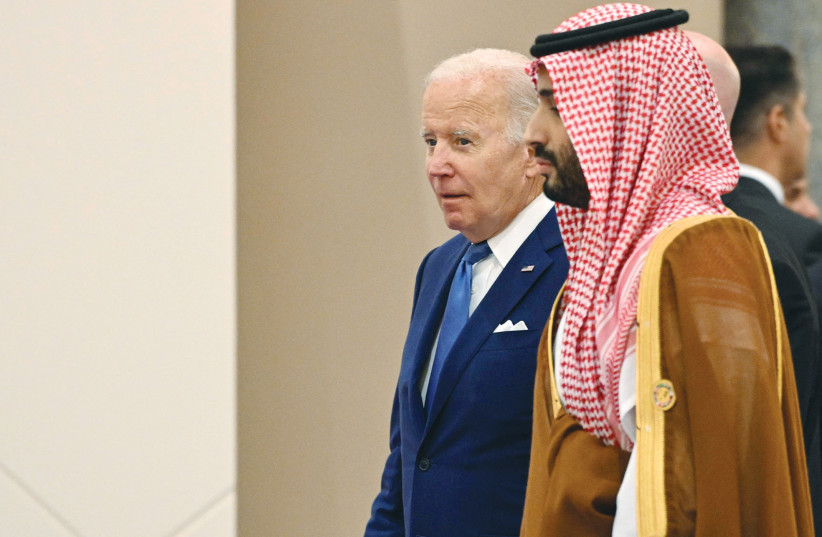
 US PRESIDENT Joe Biden and Saudi Crown Prince Mohammed bin Salman attend the Gulf Cooperation Council +3 meeting in Jeddah, last summer. (photo credit: MANDEL NGAN/REUTERS)
US PRESIDENT Joe Biden and Saudi Crown Prince Mohammed bin Salman attend the Gulf Cooperation Council +3 meeting in Jeddah, last summer.
(photo credit: MANDEL NGAN/REUTERS)
Saudi Arabia will not hold up a peace deal even if Israel does not offer major concessions to Palestinians in their bid for statehood, three regional sources familiar with the talks said.

The Palestinians could get some Israeli restrictions eased but such moves would fall short of their aspirations for a state. As with other Arab-Israeli deals forged over the decades, the Palestinian core demand for statehood would take a back seat, the three regional sources familiar with the talks said.

“The normalization will be between Israel and Saudi Arabia. If the Palestinians oppose it the kingdom will continue in its path,” said one of the regional sources. “Saudi Arabia supports a peace plan for the Palestinians, but this time it wanted something for Saudi Arabia, not just for the Palestinians.”

The Saudi government and the US State Department did not respond to emailed questions about this article.

Netanyahu hails possibility of historic peace

Prime Minister Benjamin Netanyahu has hailed the possibility of a “historic” peace with Saudi Arabia, the heartland of Islam. But to secure the prize, Netanyahu has to win the approval of parties in his a far-right coalition which reject any concessions to the Palestinians.

MbS said in a Fox News interview this month that the kingdom was moving steadily closer to normalizing ties with Israel. He spoke about the need for Israel to “ease the life of the Palestinians” but made no mention of Palestinian statehood.

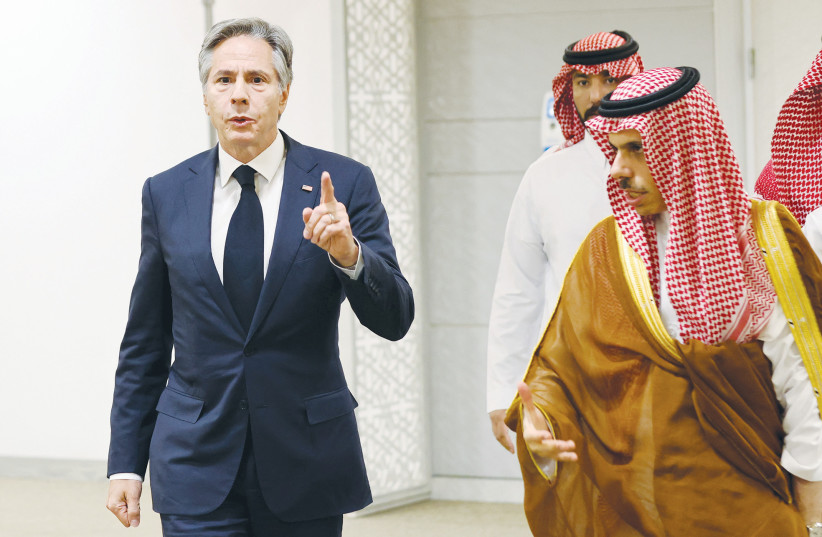
 US SECRETARY of State Antony Blinken walks with Saudi Arabia’s Foreign Minister Prince Faisal bin Farhan during a visit to Riyadh, in June.  (credit: Ahmed Yosri/Reuters)
US SECRETARY of State Antony Blinken walks with Saudi Arabia’s Foreign Minister Prince Faisal bin Farhan during a visit to Riyadh, in June. (credit: Ahmed Yosri/Reuters)

Nevertheless, diplomats and the regional sources said MbS was insisting on some commitments from Israel to show he was not abandoning the Palestinians and that he was seeking to keep the door open to a two-state solution.

Those would include demanding Israel transfer some Israeli-controlled territory in the West Bank to the Palestinian Authority (PA), limit Jewish settlement activity and halt any steps to annex parts of the West Bank. Riyadh has also promised financial aid to the PA, the diplomats and sources said.

Palestinian President Mahmoud Abbas has said any bargain must recognize the Palestinian right to a state within the 1967 borders, including East Jerusalem, and must stop Israeli settlement building. However, all the sources said a Saudi-Israeli deal was unlikely to address those flashpoint issues.

Netanyahu has said Palestinians should not have a veto over any peacemaking deal.

Can Israel-Saudi peace deal get support of US Congress?

Yet, even if the US, Israel, and Saudi Arabia agree, winning support from lawmakers in the US Congress remains a challenge.

Republicans and those in Biden’s Democratic Party have previously denounced Riyadh for its military intervention in Yemen, its moves to prop up oil prices, and its role in the 2018 killing of Saudi journalist Jamal Khashoggi, who worked for the Washington Post. MbS denied ordering the killing.

“What’s important for Saudi Arabia is for Biden to have the pact approved by Congress,” the first regional source said, pointing to concessions Riyadh was making to secure a deal.

For Biden, a deal that builds a US-Israeli-Saudi axis could put a brake on China’s diplomatic inroads after Beijing brokered a rapprochement between Saudi Arabia and Iran, which Washington accuses of seeking nuclear arms. Tehran denies this.

“There was a sense that the US has abandoned the region,” said one diplomat. “By courting China, the Saudis wanted to create some anxiety that will make the US re-engage. It has worked.”