Netanyahu: Iran is violating all of its nuclear commitments

Prime Minister Benjamin Netanyahu tacked the decision by the Islamic Republic to ban a third of IAEA inspectors assigned to it.
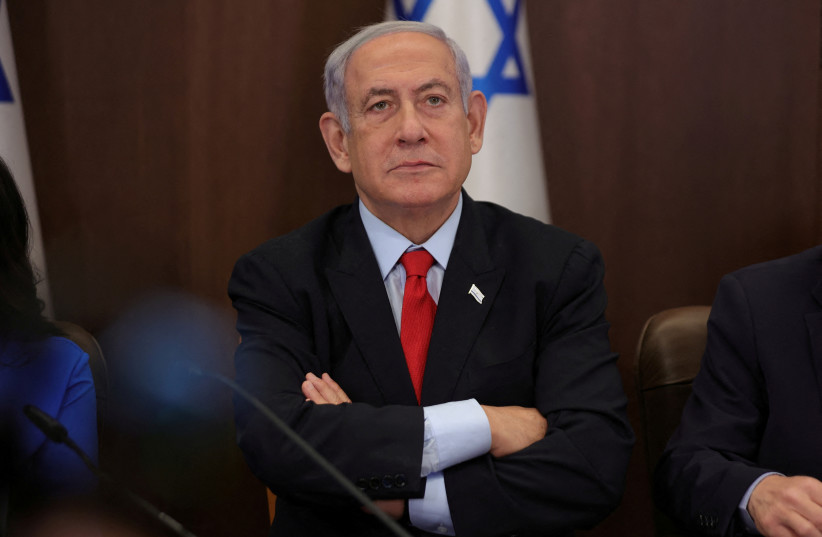
 Prime Minister Benjamin Netanyahu attends the weekly cabinet meeting in the prime minister's office in Jerusalem, 30 July 2023. (photo credit: Abir Sultan/Pool via REUTERS)
Prime Minister Benjamin Netanyahu attends the weekly cabinet meeting in the prime minister’s office in Jerusalem, 30 July 2023.
(photo credit: Abir Sultan/Pool via REUTERS)
Iran is “violating all of its commitments” in its pursuit of nuclear weapons, Prime Minister Benjamin Netanyahu charged on Saturday evening through the Prime Minister’s Office, after it was revealed the Islamic Republic had banned a third of IAEA inspectors assigned to it, hindering its oversight of Tehran’s atomic activities.

“Israel is not surprised by Iran’s moves, which prove it is continuing to violate all of its commitments to the international community,” the PMO statement read.

UN nuclear watchdog chief Rafael Grossi on Saturday condemned Iran’s “disproportionate and unprecedented” move to bar multiple inspectors assigned to the country.

Iran’s move is a response to a call led by the United States, Britain, France and Germany at the International Atomic Energy Agency’s Board of Governors this week for Tehran to cooperate immediately with the IAEA on issues including explaining uranium traces found at undeclared sites.

Grossi made clear, however, that he believed Iran had overreacted.

“I strongly condemn this disproportionate and unprecedented unilateral measure which affects the normal planning and conduct of agency verification activities in Iran and openly contradicts the cooperation that should exist between the agency and Iran,” he said in a statement.

Are Iran’s actions legal?

Iran’s move, known as “de-designation” of inspectors, is allowed; member states can generally veto inspectors assigned to visit their nuclear facilities under the nuclear Non-Proliferation Treaty (NPT) and each country’s safeguards agreement with the agency governing inspections.

But the IAEA said Tehran’s decision went beyond normal practice. It said Iran had told it that it would bar “several” inspectors, without giving a number.
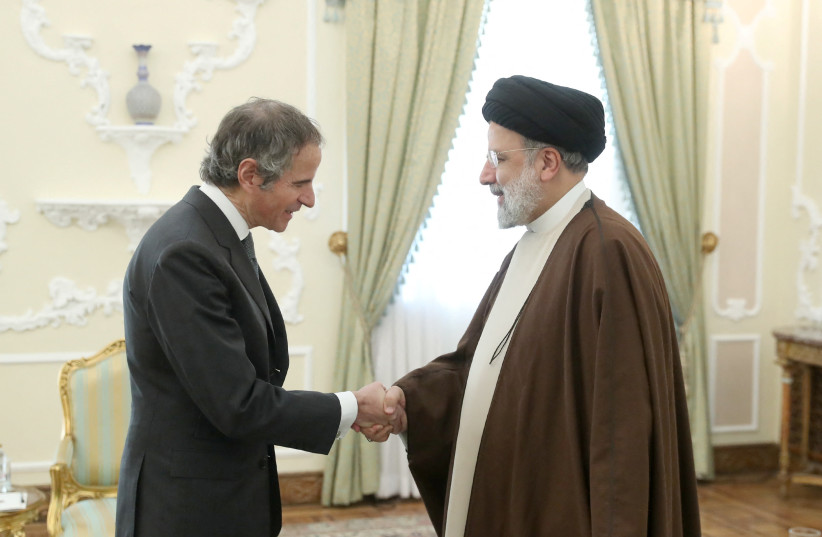
 Iranian President Ebrahim Raisi shakes hands with International Atomic Energy Agency (IAEA) Director General Rafael Grossi in Tehran, Iran, March 4, 2023. (credit: Iran's President Website/WANA (West Asia News Agency)/Handout via REUTERS)
Iranian President Ebrahim Raisi shakes hands with International Atomic Energy Agency (IAEA) Director General Rafael Grossi in Tehran, Iran, March 4, 2023. (credit: Iran’s President Website/WANA (West Asia News Agency)/Handout via REUTERS)

“These inspectors are among the most experienced agency experts with unique knowledge in enrichment technology,” the agency said. “With today’s decision, Iran has effectively removed about one third of the core group of the Agency’s most experienced inspectors designated for Iran.”

A Vienna-based diplomat said Iran had de-designated all the French and German members of the IAEA inspection team. There were already no US or British members.

“This measure, while formally permitted by the NPT Safeguards Agreement, has been exercised by Iran in a manner that affects in a direct and severe way the ability of the IAEA to conduct effectively its inspections in Iran,” the IAEA said.

Grossi added: “I call upon the Iranian Government to reconsider its decision and to return to a path of cooperation with the Agency.”

The US State Department did not immediately respond to a request for comment.

G77+China summit in Cuba calls for new global order

Report hints at formation of Russia-China-India bloc

Source: Unsplash

The G77+China, a group of developing and emerging countries representing 80 percent of the world’s population, kicked off a summit in Cuba Friday with a call to “change the rules of the game” of the global order.

The meeting comes at a time of growing frustration with the Western-led world order amid widening differences over the Russian war in Ukraine, the fight against climate change, and the global economic system.

“After all this time that the North has organized the world according to its interests, it is now up to the South to change the rules of the game,” Cuban President Miguel Diaz-Canel said at the opening of the summit.

Diaz-Canel said that developing countries were the main victims of a “multidimensional crisis” in the world today, from “abusive unequal trade” to global warming.

United Nations chief Antonio Guterres is joining some 30 heads of state and government from Africa, Asia and Latin America at the two-day summit in Havana.

At the opening of the meeting he called for a world that was “more representative and responsive to the needs of developing economies”, stressing that these countries were “trapped in a tangle of global crises.”

The bloc was established by 77 countries of the global South in 1964 “to articulate and promote their collective economic interests and enhance their joint negotiating capacity,” according to the group’s website.

Today it has 134 members, among which the website lists China although the Asian giant says it is not a full member.

Cuba took over the rotating presidency in January.

Latin American leaders such as Venezuela’s Nicolas Maduro, Colombia’s Gustavo Petro, and Argentina’s Alberto Fernandez were present at the summit, alongside Palestinian leader Mahmoud Abbas, Angola’s Joao Lourenco and Mozambican President Filipe Nyusi.

Brazilian President Luiz Inacio Lula da Silva will arrive on Friday night.

– ‘Unjust’ international order –


China is represented by top Communist Party official Li Xi, who said his country “will always make South-South” cooperation a priority” in its dealings with the outside world.

The meeting should conclude Saturday with a statement underscoring “the right to development in an increasingly exclusive, unfair, unjust and plundering international order,” the foreign minister of host Cuba, Bruno Rodriguez, told reporters on Wednesday.

A draft of the closing statement underlines the many obstacles facing developing nations, and includes “a call for the establishment of a new economic world order,” he said.

Guterres has recently attended a rash of multilateral summits, including a gathering of the G20 club of major economies in India and the BRICS group that includes Russia.

Ahead of the Havana meeting, Guterres said “this multiplicity of summits reflects the growing multipolarity of our world.”

And he warned that “multipolarity could be a factor for escalating geostrategic tensions, with tragic consequences.”

The G77 meeting comes after key changes in global blocs.

The African Union has joined the G20 group of the world’s most powerful economies, and the BRICS — Brazil, Russia, India, China and South Africa — trade group for emerging economies has expanded to admit six new members.


– ‘A valid interlocutor’ –


The presence of world leaders on its soil amounts to a recognition for the Cuban government even as the country battles its worst economic crisis in 30 years, one analyst told AFP.

“Despite the difficulties of the moment, Cuba has been recognized as a valid interlocutor,” said Cuban international relations expert Arturo Lopez-Levy, a visiting professor at the Autonomous University of Madrid.

The communist-ruled island is still under the yoke of US sanctions first imposed in 1962.

Diaz-Canel has in recent months represented the G77+China at several international meetings including a June global financial summit in Paris and an EU meeting in July with Latin American and Caribbean states.


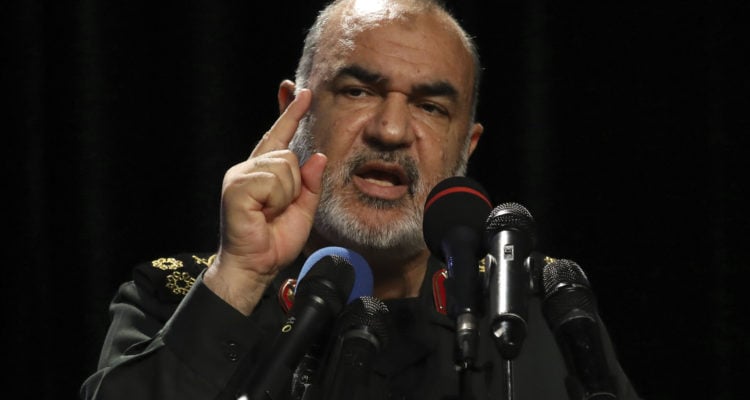
Major General Hossein Salami also claimed that the U.S.’ declining power means military action is no longer a viable option for it. 

By World Israel News Staff

In response to recent warnings issued by Mossad Director David Barnea, Major General Hossein Salami, the chief of Iran’s Revolutionary Guard Corps, issued a stern threat to Israel, cautioning that any threat to Iran’s security would bring a prompt end to Israel’s existence.

“The Zionists find themselves grappling with numerous challenges, and their decline is apparent to the world. Their resort to empty rhetoric and threats against our commanders signify their desperate state,” Salami said on state-affiliated media, according to a translation by The Times of Israel.

Israel’s “life would be cut short” if Iran’s security was challenged in any way.

His inflammatory remarks come on the heels of Barnea’s warning to Iran last Sunday. The Mossad director noted an uptick in state-organized Iranian terror operations globally, emphasizing that the orchestrations were following a directive from the Iranian leadership. Barnea cautioned that if these operations resulted in harm to Israelis or Jews, the repercussions would target the “highest echelon” of Iran’s leadership.

Salami also reflected on the United States’ declining power, citing its recent military engagements in Afghanistan, Syria, Lebanon, and Iraq as evidence that military options were no longer viable for the country. He further noted the US’s waning support for Israel, linking it to a reluctance, perceived to some extent as unwillingness, to fully back the “Zionist regime”.

  WATCH: IRAN ORDERS US TO PAY $330 MILLION FOR ‘PLANNING COUP’

During his speech at the Institute for Counter-Terrorism Policy’s conference at Reichman University in Herzliya earlier this week, Barnea said Israel was increasingly worried about Russia’s sale of advanced weapons to Iran, saying it could “threaten our existence.” He also disclosed that the intelligence agency had successfully thwarted 27 Iranian attacks targeting Jews and Israelis overseas in the past year.