The prime minister is committed to “making any deal with the Saudis possible, even at the price of toppling his own government,” HaModia reported.

Israeli Prime Minister Benjamin Netanyahu and Saudi Arabian Crown Prince Mohammed Bin Salman (photo credit: MARC ISRAEL SELLEM/REUTERS)
Israeli Prime Minister Benjamin Netanyahu and Saudi Arabian Crown Prince Mohammed Bin Salman
(photo credit: MARC ISRAEL SELLEM/REUTERS)

Prime Minister Benjamin Netanyahu on Friday denied ultra-Orthodox reports he was preparing for the collapse of his government in return for a US-backed normalization deal with Saudi Arabia.

According to a report published in the Agudat Yisrael-affiliated haredi paper HaModia on Friday morning, Netanyahu had resigned to the fact that “his political career is nearing an end.”

Netanyahu, in accordance with White House officials, will receive the long-awaited Saudi normalization deal and plea bargain for his criminal trials for his resignation, with the understanding being that he “does not have the capacity to manage the country in Israel’s current political state,” as per the report.

The prime minister is reportedly committed to “making any deal with the Saudis possible, even at the price of toppling his own government,” HaModia added.

Netanyahu’s Likud: Ultra-Orthodox report is a farfetched fabrication

The prime minister’s Likud faction hit back against the report on Friday, stating unequivocally that that report in the ultra-Orthodox newspaper is nothing but a “farfetched fabrication.”

Benjamin Netanyahu addresses a Likud faction meeting in the Knesset. (credit: OLIVIER FITOUSSI/FLASH90)Benjamin Netanyahu addresses a Likud faction meeting in the Knesset. (credit: OLIVIER FITOUSSI/FLASH90)

“There was never any commitment or request made to change the current make-up of the government [in relation to the normalization deal with Saudi Arabia].

“This government will fulfill its tenure regardless of the prime minister’s attempts to widen Israel’s circle of peace,” the Likud statement read.


US to send its first depleted uranium rounds to Ukraine

One of the officials said that the coming aid package will be worth between $240 million and $375 million depending on what is included.

 A Ukrainian serviceman walks near a destroyed Ukrainian tank, as Russia's attack on Ukraine continues, near the village of Robotyne, Zaporizhzhia region, Ukraine August 25, 2023.  (photo credit: REUTERS/Viacheslav Ratynskyi)
A Ukrainian serviceman walks near a destroyed Ukrainian tank, as Russia’s attack on Ukraine continues, near the village of Robotyne, Zaporizhzhia region, Ukraine August 25, 2023.
(photo credit: REUTERS/Viacheslav Ratynskyi)

The Biden administration will for the first time send controversial armor-piercing munitions containing depleted uranium to Ukraine, according to a document seen by Reuters and separately confirmed by two US officials.

The rounds, which could help destroy Russian tanks, are part of a new military aid package for Ukraine set to be unveiled in the next week. The munitions can be fired from US Abrams tanks that, according to a person familiar with the matter, are expected be delivered to Ukraine in the coming weeks.

One of the officials said that the coming aid package will be worth between $240 million and $375 million depending on what is included.

The value and contents of the package were still being finalized, the officials said. The White House did not immediately respond to a request for comment.

Controversy surrounding the planned aid package

Although Britain sent depleted uranium munitions to Ukraine earlier this year, this would be the first US shipment of the ammunition and will likely stir controversy. It follows an earlier decision by the Biden administration to provide cluster munitions to Ukraine, despite concerns over the dangers such weapons pose to civilians.

 A road sign damaged by cluster munition is seen following a military strike, amid Russia's attack on Ukraine, on the outskirts of Kharkiv, Ukraine June 10, 2022.  (credit: REUTERS/IVAN ALVARADO)A road sign damaged by cluster munition is seen following a military strike, amid Russia’s attack on Ukraine, on the outskirts of Kharkiv, Ukraine June 10, 2022. (credit: REUTERS/IVAN ALVARADO)

The use of depleted uranium munitions has been fiercely debated, with opponents like the International Coalition to Ban Uranium Weapons saying there are dangerous health risks from ingesting or inhaling depleted uranium dust, including cancers and birth defects.

A by-product of uranium enrichment, depleted uranium is used for ammunition because its extreme density gives rounds the ability to easily penetrate armor plating and self-ignite in a searing cloud of dust and metal.

While depleted uranium is radioactive, it is considerably less so than naturally occurring uranium, although particles can linger for a considerable time.

The United States used depleted uranium munitions in massive quantities in the 1990 and 2003 Gulf Wars and the NATO bombing of former Yugoslavia in 1999.

The U.N. nuclear watchdog, the International Atomic Energy Agency, says that studies in former Yugoslavia, Kuwait, Iraq and Lebanon “indicated that the existence of depleted uranium residues dispersed in the environment does not pose a radiological hazard to the population of the affected regions.”

Still, the radioactive material could add to Ukraine’s massive post-war clean-up challenge. Parts of the country are already strewn with unexploded ordnance from cluster bombs and other munitions and hundreds of thousands of anti-personnel mines.

The Wall Street Journal reported in mid-June the US was considering sending depleted uranium rounds to Ukraine.

Recent weapons aid packages for Ukraine have included artillery, air defense missiles and ground vehicles as Ukraine’s counteroffensive grinds on. Reuters was unable to determine what else the package contained besides the depleted uranium rounds.

Funding authorization for the aid package comes through the Presidential Drawdown Authority, which authorizes the president to transfer articles and services from US stocks without congressional approval during an emergency. The material will come from US excess inventory.

The security assistance for Ukraine since the full-scale Russian invasion in February 2022 has been more than $43 billion.


Iran says it foiled Mossad plot to sabotage missile production

Iran accuses Israel of supplying potentially exploding parts for ballistic missile program.

By The Associated Press

Iran accused Israel on Thursday of trying to sabotage its ballistic missile program through faulty foreign parts that could explode, damaging or destroying the weapons before they could be used.

The Israeli prime minister’s office declined to comment on the allegation, though it comes amid a yearslong effort by both Israel and the U.S. to target Iran. A reporter also said the parts could be used in Iran’s extensive arsenal of drones, which have grown in prominence amid their use by Russia in its war on Ukraine.

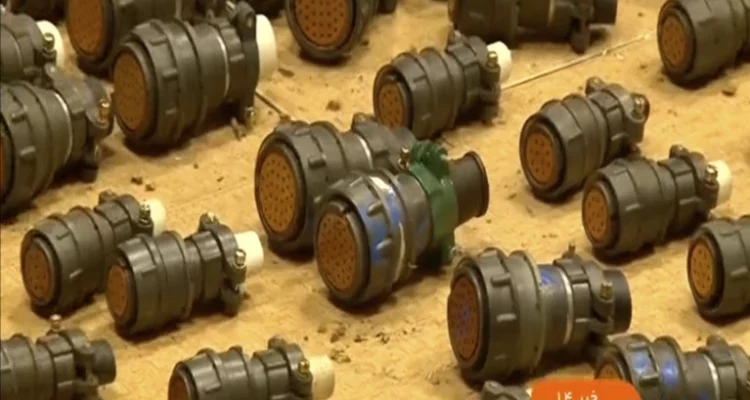
The report described the alleged Israeli operation as “one of the biggest attempts at sabotage” it had ever seen. It accused Israeli Mossad agents of supplying the faulty parts, which the state TV report described as low-price “connectors.”

Footage aired by state TV showed the alleged parts, some of them popping up into the air, as if affected by an explosive.

The pieces shown in the television report appeared to be military-style, high-density circular electrical connectors. Such connectors can be used to attach electronic components of a missile or a drone, such as its guidance computer, and pass both electricity and signals. Video released by Iran in the past showed missile scientists working with similar connectors.

  SHIN BET NABS FOUR ARAB ISRAELIS ACCUSED OF SMUGGLING IRANIAN BOMBS FOR HEZBOLLAH

“This was planted in a part called the connector, which is responsible for connecting the (computer) network of Iranian-made ballistic missiles, as well as drones,” state television military correspondent Younes Shadloo said in the report. “Apparently the part contained a modified explosive kit planted in it and was timed to explode at a certain time.”

The state TV report did not explain why Iran sought to purchase the connectors abroad, though some Iranian websites advertising such connectors suggest that Russian-made ones were the best in the market. Russia faces international sanctions over its war on Ukraine, which has seen its own supply of electronics needed for missile systems challenged.

Iranian-made drones used by Russia in the war also use circular connectors, according to reports by experts who have torn down the weapons.

The TV broadcast did not say when authorities discovered the faulty parts, nor if they had been installed in any ballistic missile prior. In May 2022, an explosion at a major Iranian military and weapons development base east of Tehran called Parchin killed an engineer and wounded another. Other blasts have struck as well, including failures in Iran’s space program that the U.S. has long criticized as advancing Tehran’s ballistic missile program.

  IRANIAN JEWISH MAN ARRESTED AT ISRAELI AIRPORT ON SUSPICION OF SPYING FOR TEHRAN

The New York Times in 2019 reported the U.S. under then-President Donald Trump had accelerated a sabotage program targeting Iran’s missile and rocket program that dated back to the administration of President George W. Bush.

The CIA declined to comment on the purported sabotage attack.

Iran’s paramilitary Revolutionary Guard, a hard-line force answerable only to Supreme Leader Ayatollah Ali Khamenei, oversees the country’s ballistic missile arsenal.

Fabian Hinz, a missile expert and research fellow at the International Institute for Strategic Studies who examined the state TV footage of the parts, said the circular connectors “are used in almost every type of ballistic missile.”

“It’s quite likely Iran purchases these connectors from abroad,” Hinz said. “This is not the first time Iran is talking about components being tampered with to sabotage the missile program.”

Israel also has been suspected in a series of targeted slayings of nuclear scientists in Iran. Sabotage attacks also have damaged Iranian nuclear sites.

The Stuxnet computer virus in the late 2000s also attacked control units for uranium centrifuges, causing the sensitive devices to spin out of control and destroy themselves. Experts widely attribute the attack to America and Israel, as does Iran.