
Hamid Dbeibah says ‘harsh measures’ will be taken after foreign minister met ‘independently’ with Israeli counterpart, but officials dispute his claim that he didn’t know about it


Libyan Prime Minister Abdul-Hamid Dbeibeh delivers a speech in Tripoli, Libya, July 24, 2023. (AP Photo/Yousef Murad)

Libyan Prime Minister Abdul-Hamid Dbeibeh delivers a speech in Tripoli, Libya, July 24, 2023. (AP Photo/Yousef Murad)

Libya’s Prime Minister Abdul Hamid Dbeibeh on Thursday rejected the prospect of normalizing relations with Israel, in his first public remarks since Israel publicized a secret meeting between the two countries’ foreign ministers, which received massive blowback in Tripoli.

“We affirm our rejection of any form of normalization,” Dbeibeh said during a televised ministerial meeting. “Long live Libya, long live Palestine, and long live the Palestinian cause in all of our hearts,” he said.

“Unfortunately, there was an individual in the government who acted independently,” Dbeibeh said in reference to Libyan Foreign Minister Najla Mangoush’s decision to meet with her Israeli counterpart Eli Cohen.

State of Jerusalem: The Maqdasyin

Loaded: 7.92%

Hours after Cohen’s office issued a statement revealing the meeting on Sunday, Dbeibeh suspended Mangoush from her role and said an investigation panel would be formed to look into the meeting, which took place last week. He then fired her hours later after she fled the country due to concern for her safety.

Two senior Libyan government officials previously told The Associated Press that Dbeibeh did in fact know about the talks between his foreign minister and the Israeli minister. One of the officials said the Libyan prime minister gave his approval for the meeting, while the second said Mangoush then briefed the prime minister about it after her return to Tripoli.
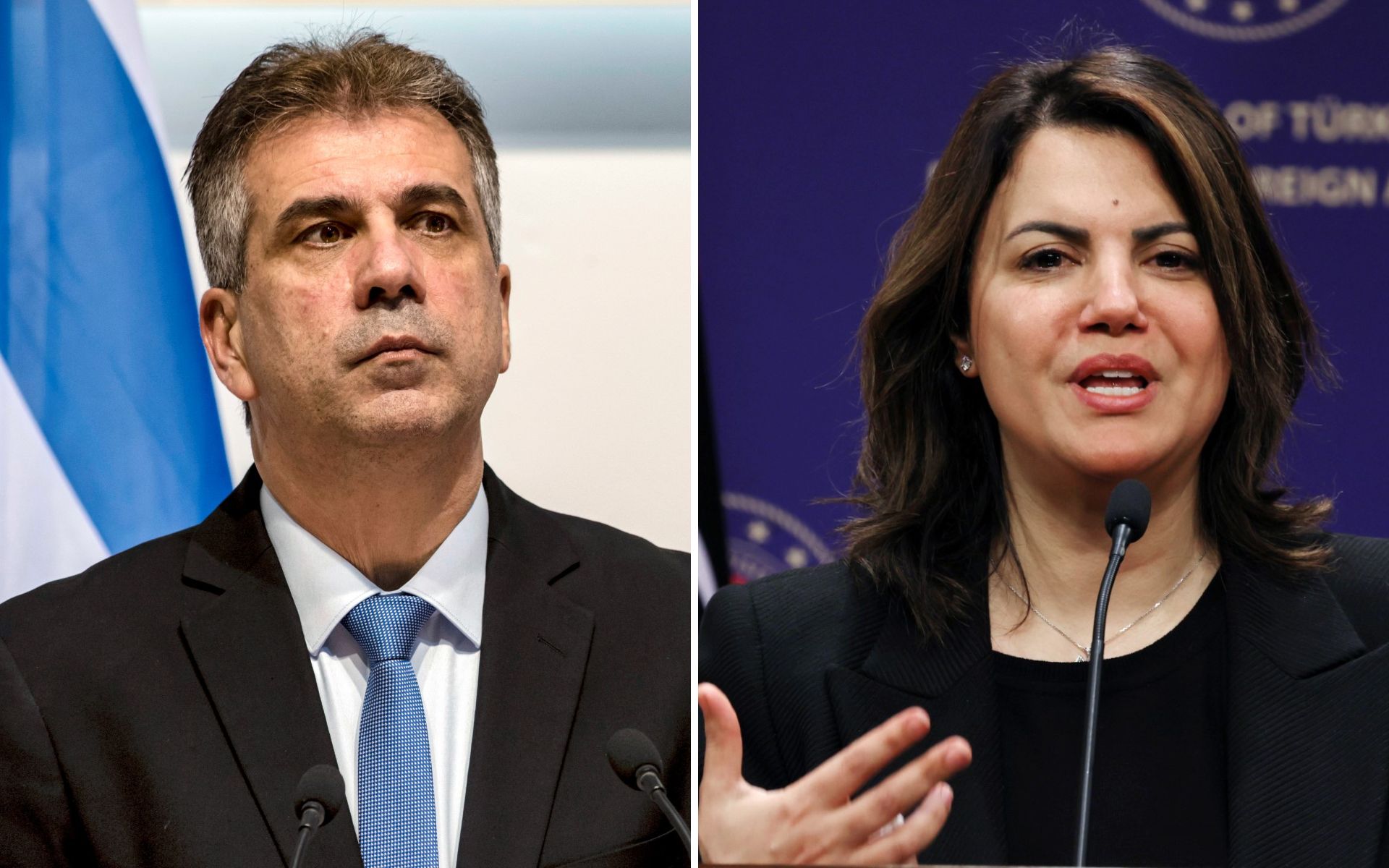
A composite image of Israeli Foreign Minister Eli Cohen (left), and Libyan Foreign Minister Najla Mangoush (right), (Iakovos Hatzistavrou/AFP; Adem Altan/AFP)

“Harsh measures” would be taken in response, Dbeibeh added during his Thursday remarks, but provided no further details.

Israel’s Foreign Ministry declined to comment on Dbeibeh’s latest remarks.

Libya slid into chaos after a NATO-backed uprising toppled longtime dictator Muammar Gaddafi in 2011. For years, the country has split between the Western-backed government in Tripoli and a rival administration in the country’s east. Each side has been backed by armed groups and foreign governments.

Prime Minister Benjamin Netanyahu also had prior knowledge of the Rome meeting, according to Hebrew media reports, which confirmed the belief of analysts that it’s unlikely either Mangoush or Cohen would have held the unprecedented meeting without informing their respective premiers.

In an apparent effort to distance himself from the outcry, Netanyahu issued a directive on Tuesday requiring all secret diplomatic gatherings to be approved by his office and also demanded that the publicizing of any covert diplomatic meetings first be given a green light by the PMO.
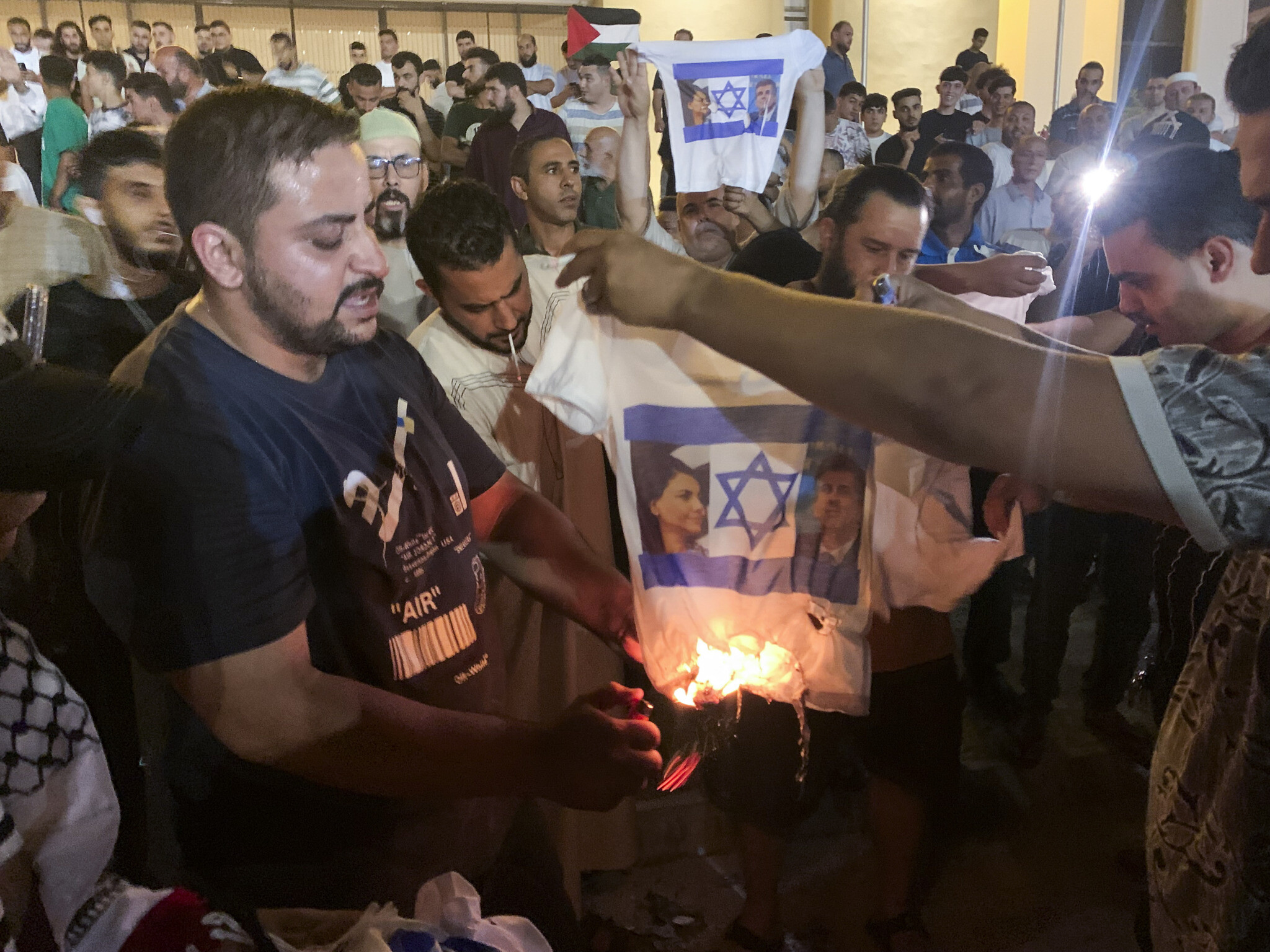
People burn a shirt showing Israeli Foreign Minister Eli Cohen and his Libyan counterpart Najla Mangoush in Tripoli, Libya, August 27, 2023. (AP/Yousef Murad)

An unnamed source in the Mossad spy agency was quoted by Channel 12 as saying that in publicizing the meeting, Cohen “has dealt immense damage to the ties formed in recent years,” adding: “He burned the bridge. It’s irreparable.”

The Foreign Ministry on Monday initially reacted with a statement trying to shift responsibility for Cohen’s announcement by claiming he intended to beat the imminent publication in Hebrew media of a leaked report of the encounter, which neither his office nor the ministry were behind.

Cohen lashed out over the hubbub Monday night, castigating “political opponents who have not advanced any significant achievement” for their “rush to react without knowing the details.”

Libyans reacted with outrage to Cohen’s announcement of the meeting and scattered protests broke out Sunday night in Tripoli and other western Libyan towns.
Senior White House adviser Amos Hochstein said it was “natural” to look into the issue following the delineation in 2022 of the maritime border between the two countries.

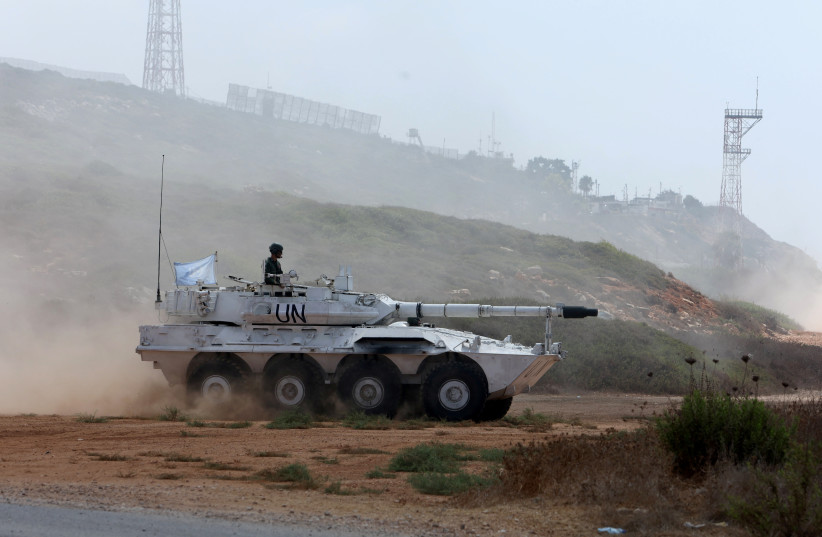
 A United Nations peacekeeper (UNIFIL) is pictured on a UN armoured vehicle in Naqoura, near the border with Israel, southern Lebanon, August 31, 2023. (photo credit: REUTERS/AZIZ TAHER)
A United Nations peacekeeper (UNIFIL) is pictured on a UN armoured vehicle in Naqoura, near the border with Israel, southern Lebanon, August 31, 2023.
(photo credit: REUTERS/AZIZ TAHER)

The United States is exploring the possibility of resolving the long-standing border dispute between Lebanon and Israel, senior White House adviser Amos Hochstein said on Thursday at the end of a two-day visit to Lebanon.

Hochstein said it was “natural” to look into the issue following the delineation in 2022 of the maritime border between the two countries, which paved the way for offshore exploration activities to begin on behalf of Lebanon last week.

The senior White House adviser said he visited southern Lebanon during his trip “to understand and learn more about what is needed to be able to potentially achieve an outcome.”

“It is time for me to hear from the other side, and to make an assessment if this is a right time,” he said.

The current demarcation line between the two countries is known as the Blue Line, a frontier mapped by the United Nations that marks the line to which Israeli forces withdrew when they left south Lebanon in 2000.

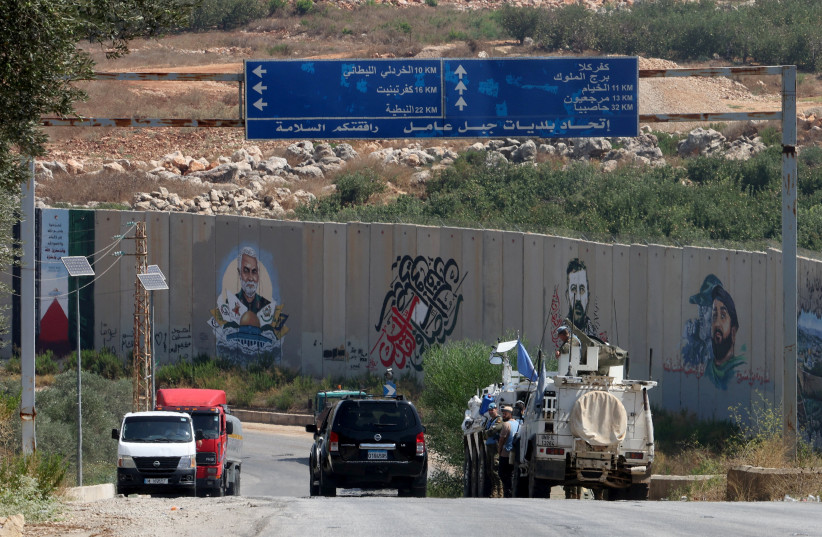
 UN peacekeepers (UNIFIL) stand near their vehicles in Kfar Kila village near the border with Israel, southern Lebanon, August 31, 2023. (credit: REUTERS/AZIZ TAHER)UN peacekeepers (UNIFIL) stand near their vehicles in Kfar Kila village near the border with Israel, southern Lebanon, August 31, 2023. (credit: REUTERS/AZIZ TAHER)

Blue Line border tensions

Tensions have flared along it this summer, with rockets being fired at Israel during flare-ups of Israeli-Palestinian violence, and members of the heavily armed Lebanese group Hezbollah or its supporters facing off with Israeli forces.

Lebanon’s caretaker foreign minister Abdallah Bou Habib said last week that determining the land border could put an end to those tensions.

For Israel, the land dispute is part of the larger conflict with Lebanon and the Iranian proxy group Hezbollah. It operates within Lebanon and has a strong military presence along Israel’s border.

Israel has blamed the growing border friction on Iran, which it said is attempting to create a ring of violence along the country’s borders, in Gaza, Lebanon and the West Bank.

An Israeli source that Israel and Lebanon are “very far” from settling their land disputes.


Hamas said considering resuming mass protests along Gaza border

As living conditions worsen in impoverished coastal strip, terror group is looking for ways to put pressure on Israel and international donors

Palestinian protesters run to cover from tear gas during clashes with Israeli troops, along the frontier with Israel, east of Gaza City, Monday, August 21, 2023. (AP Photo/Adel Hana)

Palestinian protesters run to cover from tear gas during clashes with Israeli troops, along the frontier with Israel, east of Gaza City, Monday, August 21, 2023. (AP Photo/Adel Hana)

After hundreds of Gazans staged a violent protest near the border with Israel on August 21, with some hurling explosive devices or attempting to break through the security barrier, Hamas is now reportedly considering a resumption of regular protest marches along the border and other activities against Israel,

On Wednesday, photographers were invited to the area along the security fence to document ongoing works to clear the ground, Haaretz reported. The publicity stunt was reportedly intended to signal to Israel that Hamas has the capabilities to resume activities along the border, such as organizing violent rallies and launching incendiary balloons.

However, the group has not reached a final decision on whether to go ahead, according to Haaretz. In preparation for possible protest actions, tents will be set up near the border in the next few days, sources said.

State of Jerusalem: The Maqdasyin

Loaded: 10.30%

Weekly protests along the frontier began at the end of March 2018 and continued almost every Friday until the end of 2019, with the demand that Israel lift its restrictions on the movement of people and goods into and out of the coastal enclave and calling for the return of Palestinian refugees and their descendants to lands that are now a part of the Jewish state.

The protests frequently included violence, including the hurling of explosives, rocks and firebombs at IDF soldiers, as well as attempts to storm and sabotage the border fence, and in some cases live fire toward Israeli soldiers. Troops often responded with rubber-coated bullets and tear gas as well as live fire. More than 200 Palestinians were killed at the demonstrations and thousands were injured.

In addition, Palestinians regularly flew helium balloons into Israel carrying explosives and incendiary devices, sparking fires that destroyed large swaths of foliage.

While Hamas is said to now consider resuming the ”Marches of Return,” as they came to be known, no official statement has yet been published by the terror group on its future plans.

Palestinian flags fly near the border between the Gaza Strip and Israel near an observation point manned by Hamas fighters east of Jabalia on August 30, 2023. (Mahmud Hams/AFP)

According to Haaretz, the terror group ruling over the coastal enclave is not interested in a major military confrontation with Israel at this point, but it wants to convey a message to Israel, the UN and Qatar, and to pressure them to improve humanitarian conditions. Hamas also wants to emphasize that the situation in Gaza cannot be detached from what is happening in the West Bank, where terror attacks have become increasingly frequent.

On Thursday, Gazan farmers staged a protest along the border in the central Gaza Strip, lamenting restrictions on the export of agricultural produce, on the movement and training of agricultural experts, and on the limitation of arable lands along the border, where Israel imposes a buffer zone that sometimes reaches half a kilometer, a spokesman for the Ministry of Agriculture said to Hamas-affiliated Shehab News.

Living conditions in the impoverished enclave have worsened in recent months, due in part to a delay in Qatar’s aid disbursement intended to pay salaries for 50,000 public sector workers. The Gazan economy is highly dependent on foreign aid, and Qatar has been donating $30 million per month in public sector payroll grants, aid for low-income families, and fuel for electricity.

The deepening humanitarian crisis, with wages currently reduced or suspended for public sector employees, constant power outages and discontent with the Hamas leadership, led thousands to take to the streets in late July, in a rare expression of popular discontent that was rapidly suppressed by the ruling terror group.