
Four soldiers killed in alleged Israeli strikes on Syria

Four other Syrian soldiers were also wounded in the attack.
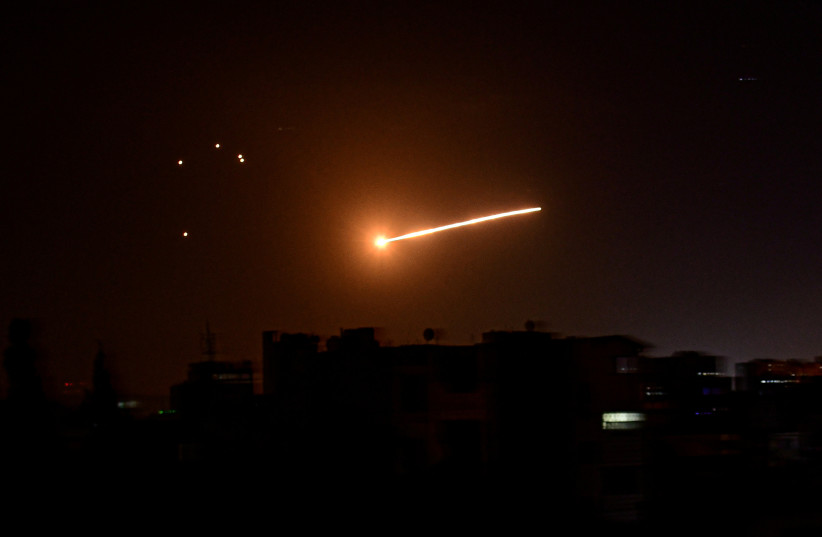
A streak of light is seen in the night sky in the vicinity of the Syrian capital Damascus during what Syrian authorities said was an Israeli air strike, in this handout released by state news agency SANA on February 24, 2020.
(photo credit: SANA/HANDOUT VIA REUTERS)

Four Syrian soldiers were killed and four others were wounded in alleged Israeli airstrikes targeting sites near Damascus early Monday morning, according to Syrian state media.

A Syrian military source told the Syrian state media outlet SANA that the airstrikes were conducted from the direction of the Golan Heights, adding that material damage was also caused in the strikes.

The Syrian Capital Voice news site reported that the strikes targeted sites near Saidnayah and Mneen, north of Damascus, hitting warehouses belonging to the Syrian military used by Iran-backed militias.

According to the report, fires erupted at the targeted sites.

During the strikes, a surface-to-air missile reportedly fell near the Syrian town of Dourin, near the border with the Golan Heights.
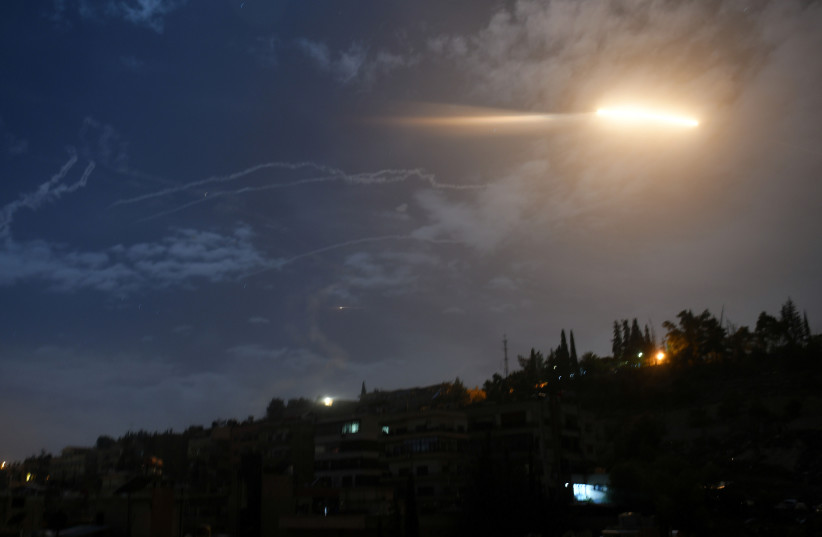
 Missile fire is seen over Damascus, Syria January 21, 2019.  (credit: SANA/HANDOUT VIA REUTERS)Missile fire is seen over Damascus, Syria January 21, 2019. (credit: SANA/HANDOUT VIA REUTERS)

Last alleged Israeli strike in Syria was reported in late July

The strikes on Monday morning were the first alleged Israeli strikes reported in Syria since late July when the Syrian Foreign Ministry accused Israel of attacking the country’s Internal Security Forces in al-Qahtaniah in the Quneitra Governorate along the border with the Golan Heights.

That attack resulted in material damage and no injuries, according the Syrian Foreign Ministry. The statement did not provide details on when exactly the strike was carried out.

In mid-July, two Syrian soldiers were injured in alleged Israeli airstrikes in the Damascus area. Reports by opposition-affiliated news sites indicated that the sites targeted in those strikes were located west of Damascus near Qudssaya or As’Saboura. Photos reportedly from the area showed multiple fires blazing after the strikes.

About two weeks before those strikes, the IDF struck a Syrian air defense battery after a Syrian air defense missile exploded mid-air over southern Israel. Additional targets in the area were hit as well.

That airstrike came shortly after reports of alleged Israeli airstrikes in the Homs Governorate in central Syria. Syrian state media reported at the time that Syrian air defenses were activated in the Homs Governorate in response to alleged Israeli airstrikes in the area. The Syrian state news agency SANA reported that no injuries were caused in the strikes.


IDF thwarts terror attack by Jenin-based cell

A joint statement by Israeli security forces said that the cell leader was taking orders from terror figures in Gaza.

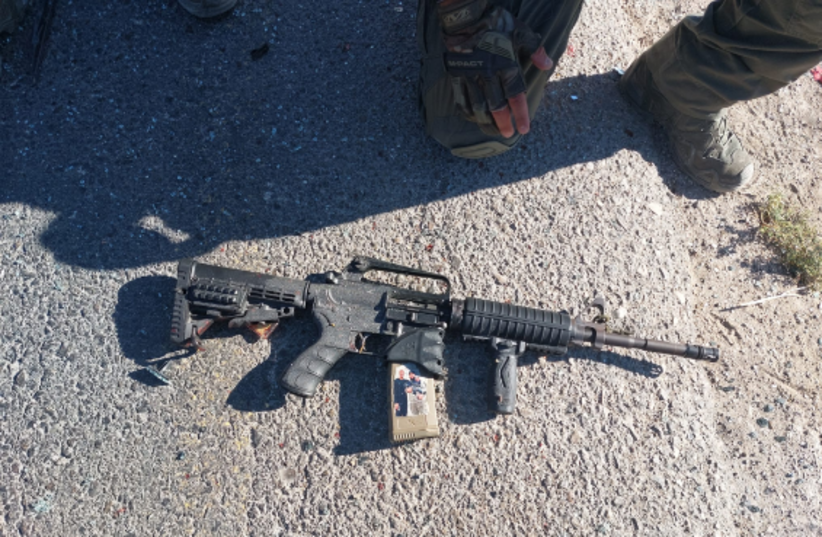
 IDF thwarts Jenin terror cell attack on August 6, 2023 (photo credit: IDF)
IDF thwarts Jenin terror cell attack on August 6, 2023
(photo credit: IDF)

A combined IDF, National Counter Terror Unit and Shin Bet operation on Sunday led to the killing of three terrorists from a Jenin-based cell on their way to carrying out a terror attack.

IDF Chief Spokesman Brig. Gen. Daniel Hagari explained that the terror group drove on Route 60 toward Mevo Dotan, near Arabe Village.

Hagari said that the terror group would perpetrate a shooting attack along the lines of past episodes in which Meir Tamari was killed.

Further, he stated that the terror cell had been involved in previous attacks.

Next, he said it was necessary to note that Israel’s security forces did not hesitate to intercept the terrorist in broad daylight and succeeded at a surgical hit that did not impact any innocent Palestinian civilians.

He said this, especially in light of claims that the IDF is no longer acting in Jenin to give the Palestinian Authority more space to reassert its authority.

Further, Hagari said that security forces had expected that the terrorists would be fighting to the death since they were being intercepted in the middle of their operation and not at a safehouse by surprise, so there was less chance of taking them alive.

In addition, he said that the IDF did not consider using a drone in this case because the more surgical way to remove the threat was by using nearby forces on the ground.

Initial reports said two were killed, but later official reports said three died, including the cell leader, Naif Abu Sawiss, 26.

A joint statement by Israeli security forces said that the cell leader was taking orders from terror figures in Gaza, though Hagari said it was not 100% clear from which organization.

Social media posted videos of an extended gunfight between Israeli security forces and the terrorists.

The Shin Bet provided intelligence to the cooperating security forces to intercept the terrorist before they could leave the Jenin area.

Security forces found and seized an M-16 and ammunition inside the cell’s vehicle.

“I commend the security forces and the IDF for thwarting the terrorist cell that was planning an attack against Israeli civilians,” said Prime Minister Benjamin Netanyahu. “We will continue to act against those who seek to harm us, wherever and whenever.”

This crackdown occurred 24 hours after a terror attack from Jenin-area terrorists shook Tel Aviv on Saturday night.


Iran is Taking Over Key Syrian Defense Industries

(JNS) Iran is working to seize control of an extensive network of Syrian military industry facilities, collectively known by their French acronym of CERS, or the Scientific Studies and Research Center in English, according to a report released on Wednesday by the Alma Research and Education Center.

The Alma Center is a defense research group that specializes in security challenges faced by Israel in Lebanon and Syria.

The report also warned of the possibility of Hezbollah taking possession of chemical substances present as CERS, which are being stored by the Assad regime, and using them to produce chemical weapons for use against Israeli military forces or civilians in a future conflict.

Israel Defense Forces Maj. (res.) Tal Beeri, head of research at the Alma Center, told the Tazpit Press Service that “the prominent takeover of the Syrian defense industries by Iran is expressed through its takeover of CERS. Today, the Syrian CERS Center operates under full Iranian patronage.”

According to the report, CERS, which employs some 20,000 people—Syrian researchers, engineers and military officers—is spread out across Syria, and produces advanced weapons such as the “Fateh 110” surface-to-surface missile. The “Fateh 110” is at the heart of the joint Iranian- Syrian and Hezbollah precision-missile project, the report noted.

“In addition, the CERS Center is responsible for developing and manufacturing chemical, biological and potentially nuclear weapons,” it stated.

Iran views CERS as a “growth engine” for its own effort to develop and manufacture weapons on Syrian soil, based on Iranian technology, according to the report. As such, CERS is an opportunity for Iran to bypass the logistics and risks involved in transferring some of its weapons into Syria from Iran by land, air, or sea—efforts that are often targeted by Israel.

Iran’s goal in controlling CERS is to develop and manufacture precise missiles and rockets, cruise missiles and unmanned aerial vehicles on Syrian soil, particularly using the CERS Institute 4000 at Masyaf, a well-known trouble spot that has been reportedly targeted by Israeli air strikes in previous years.

Beeri noted that Institute 4000 has two Iranian coordinators allocated to the site.

A Troubling Chemical Weapons Program

The presence of a chemical program at CERS raises troubling scenarios, the report continued.

“Unlike the military nuclear project attempted by the Syrian regime with North Korean assistance, which was thwarted by Israel in 2007, the chemical program was never foiled, despite attempts to derail it,” it stated.

“We assess that the Syrian regime now possesses extensive chemical capabilities. The Syrian regime considers the stockpiles of chemical weapons in its possession and the threat they pose as a guarantee of its survival. At will, this capability may benefit the radical Shi’ite axis led by Iran in general and Hezbollah in particular,” the report cautioned.

It added that “Hezbollah’s use of chemical weapons in the next confrontation with Israel cannot be ruled out. It is conceivable that missiles or rockets armed with chemical weapons (such as Sarin nerve gas) are being stockpiled for use by Hezbollah in one of the CERS center’s sites.”

Chemical substances stored at Masyaf could be transferred to Lebanon “if so directed,” said the report, adding, “We estimate with a high probability that in a situation of war, Israel will attack the chemical weapons stockpiles wherever they are, in Syria and/or Lebanon.”

The report went on to assess that Hezbollah likely has mortar shells and missiles designed for chemical warheads, which can be armed with the help of CERS.

According to IDF Lt. Col. Sarit Zehavi, president and founder of Alma, “During the next confrontation, would this type of weapon be used against the Israel Defense Forces or Israeli civilians by Hezbollah? And what would the risk be of another tragedy for Lebanese civilians like the Beirut Port incident?”

Beeri also noted that on February 27 this year, a Syrian colonel, an engineer named Ibrahim al-Muhammad, was killed in an explosion in his vehicle in a Damascus suburb.

“He was involved, in the context of the CERS Center activity, in the Syrian military chemical program,” said Beeri. “Why was he killed? Did the Syria regime eliminate him to cover up further tracks of its chemical program ahead of Syria’s return to the Arab League?”