
The dilemma of a preventive Israeli strike on Hezbollah

As the Iran-backed terror army provokes Israel on the border and builds its arsenal, experts assess that Iranian pressure, and the domestic crises in Lebanon and Israel, are emboldening its leader Hassan Nasrallah.
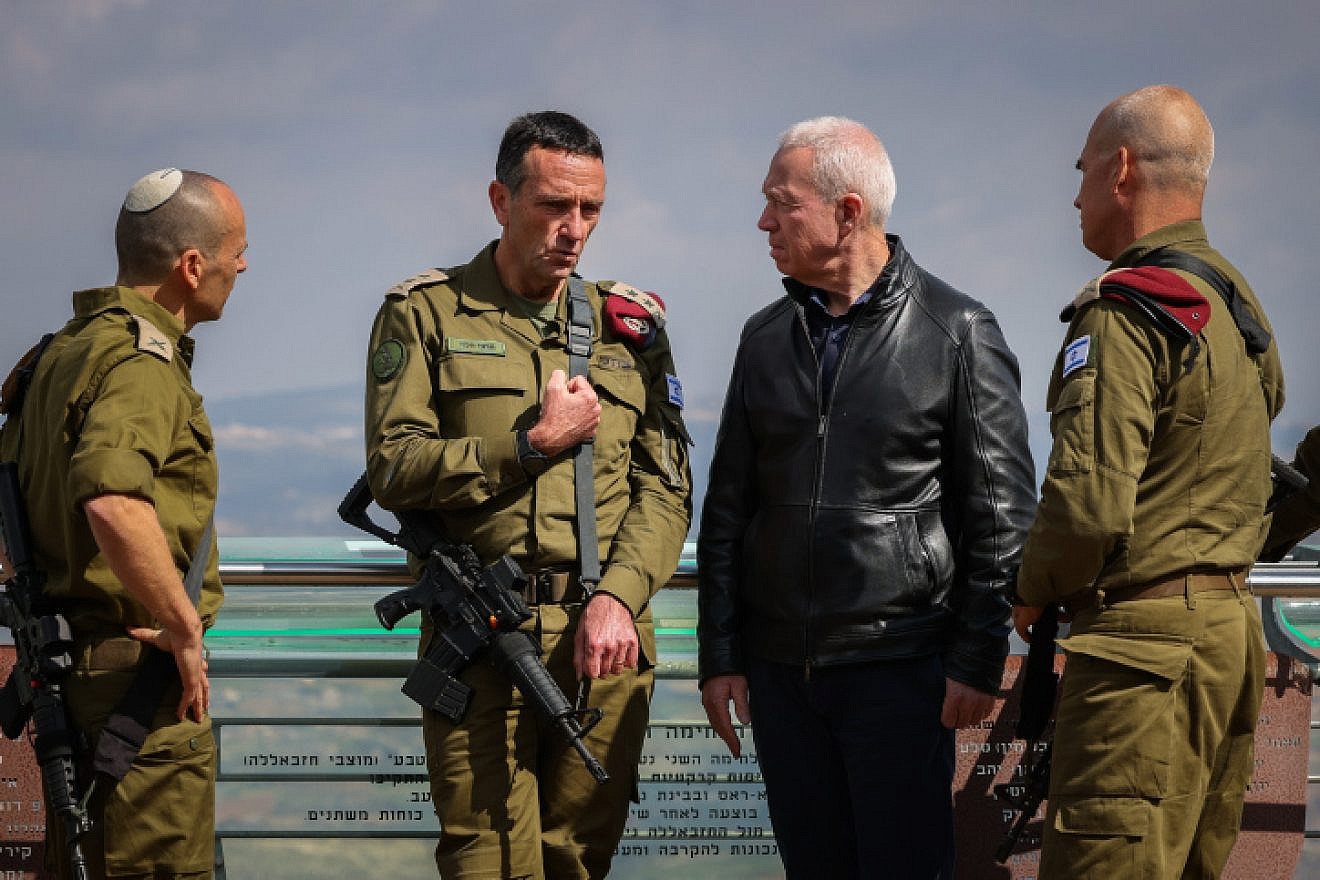
IDF Chief of Staff Lt. Gen. Herzi Halevi (second from left) and Defense Minister Yoav Gallant near the border with Lebanon, March 16, 2023. Photo by David Cohen/Flash90.

IDF Chief of Staff Lt. Gen. Herzi Halevi (second from left) and Defense Minister Yoav Gallant near the border with Lebanon, March 16, 2023. Photo by David Cohen/Flash90.

Hezbollah’s provocations on the Lebanese–Israeli border continue, while deeper within Lebanon, the Iranian-backed terror army continues to amass a monstrous arsenal of some 200,000 rockets, mortar shells, missiles and drones. Hundreds of these threats are capable of targeting strategic sites within Israel.

This situation raises the question of whether Israel needs to consider a preventive strike, as well as the dilemma that such a strike would pose to military and political decision makers.

Hezbollah’s provocations on the Lebanese–Israeli border continue, while deeper within Lebanon, the Iranian-backed terror army continues to amass a monstrous arsenal of some 200,000 rockets, mortar shells, missiles and drones. Hundreds of these threats are capable of targeting strategic sites within Israel.

This situation raises the question of whether Israel needs to consider a preventive strike, as well as the dilemma that such a strike would pose to military and political decision makers.

It is important to view the actions of Hezbollah in a wider, regional context, according to Shay.

“Iran is at the core of [Hezbollah’s] regional activities, and these activities also involve Hamas and Palestinian Islamic Jihad in Gaza. Israel is not interested in a clash that turns regional. This is the heavier threat hovering over us,” he said.

Such a conflict could involve Hezbollah in Lebanon, spread to Iranian-backed militias and Hezbollah in Syria, and drag in the Palestinian arena, he cautioned. “So long as Israel can prevent this, it will try to do that,” he said.

Israel’s ongoing campaign in Syria cannot be seen as a major preventive strike, said Mizrahi, but rather constitutes a drizzle of smaller-scale actions, which does not extend to Lebanon.

“This created a situation in which Hezbollah feels protected and continues to build up its force in Lebanon, while the quiet is preserved,” said Mizrahi.

Provocations on the border ordered by Hezbollah Secretary-General Hassan Nasrallah are not designed to lead to full conflict, Mizrahi assessed, despite Nasrallah’s growing self-confidence and willingness to take greater risks, such as the dispatching into Israel in March of a terrorist armed with a bomb.

“The Iranians want more such actions from Hezbollah, as Iran’s own global situation improves due to the Iranian role in Ukraine and its re-establishment of relations with Gulf Arab states,” she said. “The internal situation in Lebanon is also pushing Nasrallah to take steps to portray himself as ‘defender of Lebanon,’ and to justify possessing an armed force in the face of domestic critics,” she added.

“Furthermore, in the past years, the IDF has been completing its northern border security barrier, some of which, according to Hezbollah, violates the Blue Line. Nasrallah claims he is responding to this. The barrier is putting Hezbollah under pressure,” she said.

(Immediately prior to the IDF withdrawal from southern Lebanon in May 2000, the United Nations marked the line of withdrawal with blue barrels—the “Blue Line.” The IDF security barrier does not exactly follow the Blue Line, with the distance between the two being hundreds of feet in some places.)

Another factor according to Mizrahi is Israel’s own domestic political crisis, which is fueling Nasrallah’s perception of the Jewish state as unwilling to launch a major military campaign against him.

“We are clearly in a stage of heightened tensions, and opportunities for miscalculations are large. But Hezbollah believes that [limited] friction with Israel will strengthen it internally in Lebanon, and prove to Iran that it is doing something. This explains the greater risk taking,” he said.

Shay echoed the assessment that Iranian directives and domestic Lebanese needs were driving Hezbollah’s increased aggression. An anti-tank missile attack launched in July in the Har Dov area, and provocations near the village of Ghajar, all help bury criticism of Hezbollah in Lebanon, he said.

“Iran is also interested in activating pressure against Israel. Direct Iranian attempts to attack Israeli targets abroad haven’t met with much success,” said Shay. “Nasrallah’s assessment is that these are low-risk actions, that Israel is in a domestic crisis, and hence he estimates that it won’t respond in a major way.”

Yet just such assessments in Beirut are what led to the major war in 2006, he cautioned, adding, “Hezbollah has to understand that Israel reserves all options on the table.”
Probability of war in north highest since 2006, IDF says

Military officials worry Nasrallah recognizes Israeli weakness amid judicial legislation protests and may test the military’s patience despite the risk of all-out conflict

Yossi Yehoshua|

Security officials and members of the IDF said the risk of war with Hezbollah across the northern border, was the highest since the end of the Second Lebanon War in 2006. Prime Minister Benjamin Netanyahu was briefed on the concerns in a meeting convened to discuss the increasing tension with the Iran-backed terrorist organization.

The Prime Minister’s Office made the scheduled meeting known to the media and added a vague statement when it was over. It is therefore not far-fetched to assume that the government intended not only to alert the public but also to send a clear message to Hezbollah Secretary-General Hassan Nasrallah.
3 View gallery
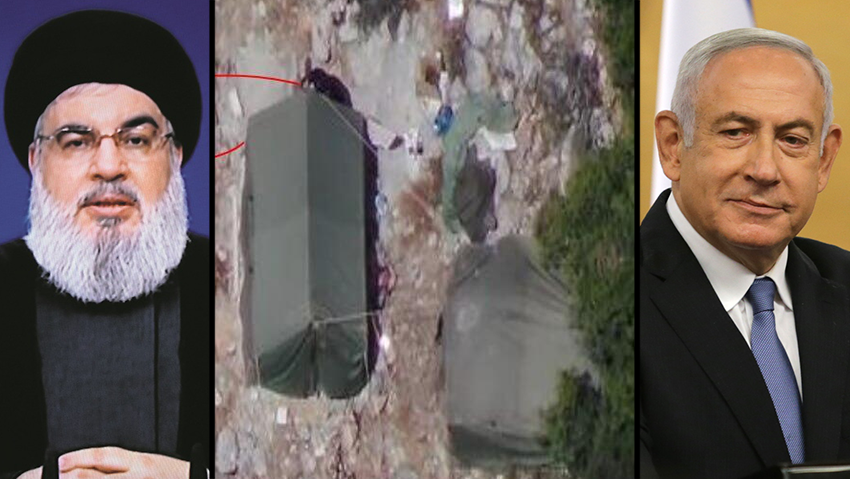
Hassan Nasrallah, Hezbollah tents in the northern border, Benjamin Netanyahu
(Photo: Alex Kolomoisky, EPA)
Netanyahu and a select group of ministers were also briefed on an attempted weapons smuggling across the Jordanian border, which officials said was meant to reach terror actors on the West Bank. Military Intelligence officials described how attempts were made to incite terror in the area, with funding transferred by the Hamas and Islamic Jihad terror factions, via local banks.
Nasrallah was changing his tactics and advancing the Radwan Unit – tasked with invading Israeli communities in the event of war, to the border area, and Iran was exerting pressure on the Lebanon- based Islamist group, to act against the IDF, the officials said in the Sunday meeting. But the security officials also noted that Tehran was not interested in an all-out war between Hezbollah and Israel.
However, Tehran also warned Hezbollah against starting a war with Israel, to avoid wasting an opportunity to retaliate, in case the IDF strikes at their nuclear facilities.
As an avid follower of Israeli media, Nasrallah seized the opportunity to warn Israel against taking action in response to his provocations.
He understands that any Israeli military action, whether in the North or the South, would benefit from the element of surprise and although there has been much media coverage of the recent incident on the northern border, secrecy will become a critical element of Israel’s success.

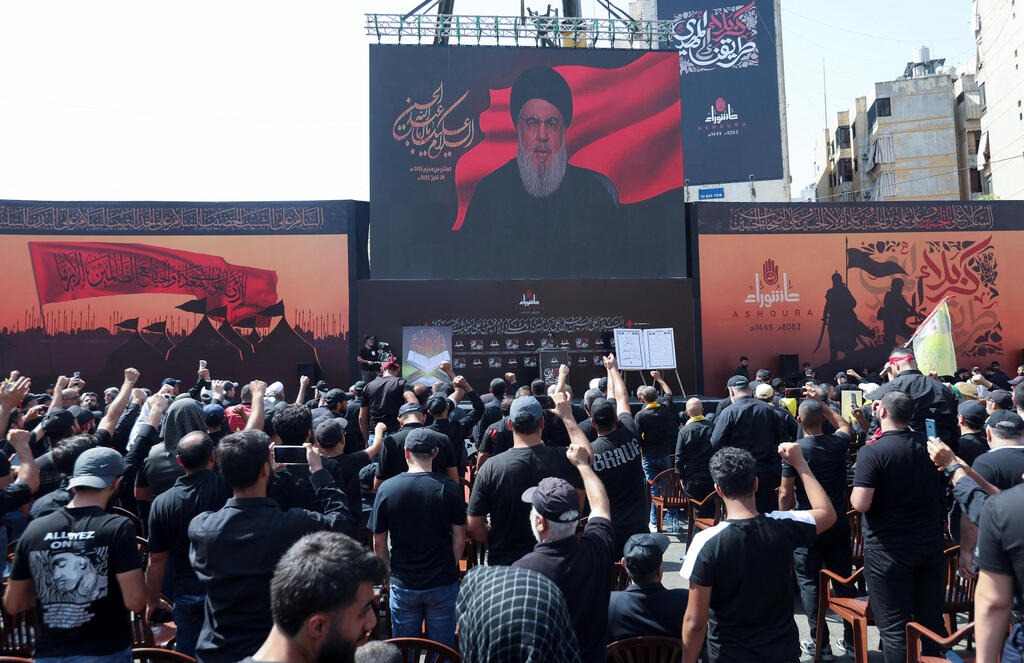
נסראללה בנאום מרחוק, בעצרת בדרום ביירות

The statement put out by the PMO after the briefing with security officials said Netanyahu accepted the military’s recommendations, to avoid conflict. The statement could be seen as the prime minister’s vote of confidence in his security officials and the IDF, but it could also be his way of avoiding responsibility should conflict be unavoidable.
Thus far, the IDF and especially the senior commander of the northern sector, have ongoing Hezbollah provocations to deal with including tents set up in Israeli territory by Hezbollah operatives, which had not been removed as well as other infringements of Israel’s sovereignty that have weakened Israel’s deterrence.
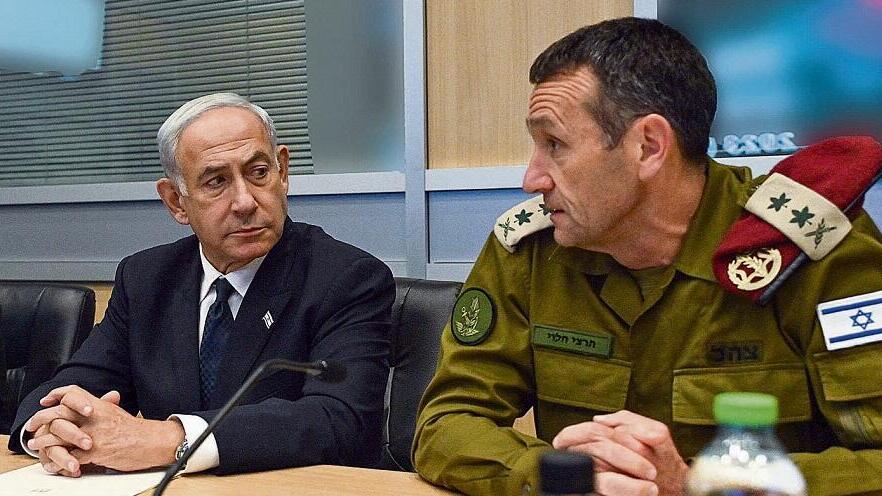
הרמטכ"ל הרצי הלוי, רה"מ בנימין נתניהו ושר הביטחון יואב גלנט
Benjamin Netanyahu and Lt. Gen. Herzi Halevi
(Photo: Kobi Gideon, GPO)
Despite rising tensions, military intelligence officials still believe Nasrallah was not interested in starting a war but was, for the first time in 17 years, willing to test Israel’s patience, and if necessary engage in a days-long round of fighting that could easily get out of control. That was the crux of the briefing Netanyahu received on Sunday.
Even if war was not imminent, warnings expressed in letters sent by senior IDF officers about the repercussions of the coalition’s legislative push to alter Israel’s judicial system, leave no room for doubt: Nasrallah sees Israel as weakened by internal conflicts and the deteriorating relations with the U.S.
IDF Chief of Staff Lt. Gen. Herzi Halevi, made sure to reflect his agreement with the assessments presented to the prime minister before and after the legislation was passed last Monday, when the prime minister finally agreed to meet with him.


Prime Minister Benjamin Netanyahu announced Sunday that “we will one day be able to have railways connect Saudi Arabia and Israel,” just hours after a New York Times piece suggested that the kingdom was expecting the Jewish state to make significant concessions to the Palestinians as a precondition for normalization.

While the train to normalization has long left the station, the rails it is traveling on will have to pass through Washington. The Biden administration has been trying for months to have the normalization be linked to a breakthrough with the Palestinians, and that explains why The New York Times – the preferred outlet for the president – ran that piece. Essentially, in order to get Riyadh, Netanyahu will have to please Ramallah, the article said. But Jerusalem officials have been rejecting this idea, and the conventional wisdom is that the royal palace in Saudi Arabia has also rejected it.

Crown Prince Mohammed Bin Salman, who has unchallenged power in the kingdom, has on more than one occasion lashed out at the Palestinians. In fact,  speaking of trains, he once told Palestinian President Mahmoud Abbas that the “normalization train has left the station; it is up to you if you want to get on board.” In other words, Riyadh is no longer willing to let Ramallah have a veto on the thawing of relations with Israel – for itself or for the Gulf in particular. That is why Bin Salman agreed to have the UAE and Bahrain sign the Abraham Accords with Israel and he himself has promoted ties with Israel unofficially.

According to one senior Israeli official, the current relationship with Riyadh is a “semi-normalization.” For Israel, it would not be worth it to pay in Palestinian currency just so they could be completed and become public, as this would be a dangerous transaction. This has been Netanyahu’s long-held view and it is not going to change. Selling the farm in exchange for worthless documents signed with the Palestinians is something that he could have done long ago.

In other words, as far as Israel is concerned, peace with Saudi Arabia should be the culmination of a much different form of negotiations. The Saudis have recently presented their demands for bolstering ties with the US, and they include far-reaching demands on economic, scientific, and security matters. The Americans have a vested interest in such a deal to check the Chinese inroads in the region and of course to ensure that they don’t lose a critical ally like Saudi Arabia. Normalization with Israel, they believe, will be a byproduct of such a large deal between Washington and Riyadh.

A senior Israeli official told Israel Hayom that “Netanyahu will not change his longstanding and principled stance on the Palestinian issue” for the sake of normalization with Saudi Arabia despite reports that it demands “significant progress” be made in Israeli-Palestinian relations before such a deal is struck.

According to the official, “a breakthrough with Riyadh depends on the talks between the kingdom and Washington. This [progress with the Palestinians] is the consideration that the Saudis are demanding, but the issue is not a high priority for them.” The official added, “The two nations have already been maintaining unofficial ties, so for Israel there is no reason to take steps that could put it under threat in Judea and Samaria for things that already exist to a large extent.

Will Jerusalem be willing to offer something in order to finalize a normalization deal? The official formula Israel has subscribed to since the new government was sworn in is that it will not “take steps that could preclude a future deal.” That is a very general statement, because no one knows what the contours of a future deal would look like, and that is why no one knows what steps could derail it.

But apart from that there is another thing: The Abraham Accords were born as a result of Israel’s willingness to have its application of sovereignty to Judea and Samaria put on hold rather than be implemented in 2020 as the first step of the Trump administration’s peace plan. According to that plan, once Israel applied its sovereignty, the Palestinians would have four years to enter into negotiations with Israel, but if they didn’t – Israel would be able to extend its sovereignty to other places. Those four years are set to expire in the summer of 2024.

What Israel can offer Bide and Saudi Arabia is to continue putting off the sovereignty issue for four more years, until the end of 2028. This is not an empty promise, since there is a very real chance of Donald Trump returning to the White House (as well as other Republican victories). Thus, such a pledge would mean that even if a hawkish Republican president takes office in Washington, the fully right-wing government in Israel will not seize the opportunity to extend its sovereignty, despite the push by many right-wing circles, which some call “annexation.”

Internal US politics is very much part of this story. The conventional wisdom in Israel is that Biden will have to decide by December whether he is all-in on such a deal. After that, the presidential campaign will be in full swing. Moreover, a full-fledged treaty with Saudi Arabia will require Senate approval with two thirds. The administration is wary that the GOP is unlikely to be inclined to give Biden as a historic accomplishment.

The normalization train may have left the station, but it is now at a stopover in Washington.